



China’s AI technology took the spotlight at this year’s Apsara Conference, Alibaba Cloud’s annual gathering held every September in Hangzhou.
Despite heavy rain and later soaring 35.5°C heat, crowds turned out in force. Excitement grew after Alibaba CEO Eddie Wu Yongming announced new AI infrastructure spending on top of the already pledged US$53 billion, sending shares to a four-year high.
Hardware, Applications, and Models
Spanning 40,000 square meters, this year’s halls focused on AI hardware, applications, and foundational models. Beijing-based analyst Poe Zhao observed a shift from last year’s emphasis on large language models. “My main takeaway was that large language models have sort of become a foundational infrastructure,” he said.
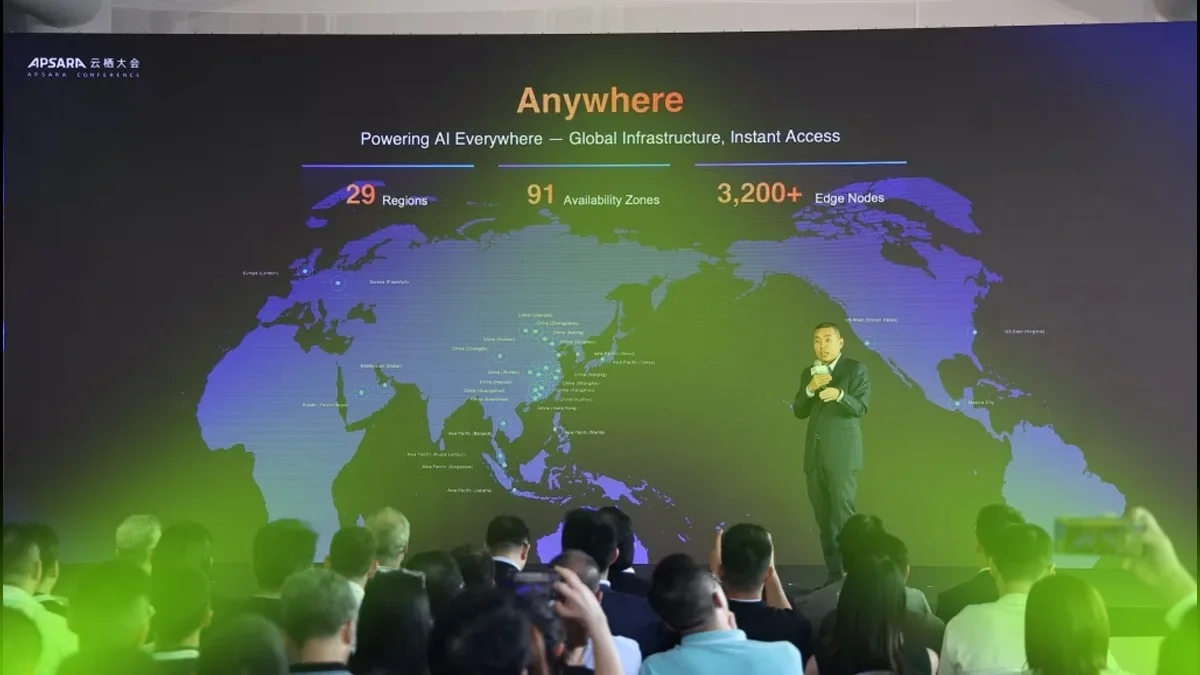
The spotlight was on AI applications built on Alibaba’s open-source Qwen family of models.
AI Agents and Real-World Uses
Companies showcased AI agents – autonomous systems that carry out tasks – in areas like vehicles, robotics, and healthcare.
Li Auto unveiled a sedan with what it claimed was China’s first in-vehicle AI agent, able to order coffee with a voice command. Banma presented its smart car solution powered by the Qwen-Omni multimodal model. Robots drew crowds too, with Galbot handing out drinks and Unitree Robotics letting families spar with a padded robot in a small ring.
Healthcare stood out as well. Tencent-backed WeDoctor announced it had become “fully AI-native.”
AI for Families
Parents were also drawn to AI companions. Zhuhai-based Autoark showcased Qiduoduo, a multimodal doll for toddlers marketed as boosting preschoolers’ chances of entering top universities like Tsinghua, Peking, or Harvard.
One visitor, Liu, brought her 5-year-old daughter to “get her familiar with AI.” CEO Wu said Alibaba’s goal is for Qwen to become the “operating system” of future technologies, much like Android, with Alibaba Cloud as the next computer.
Chips and Cloud Growth
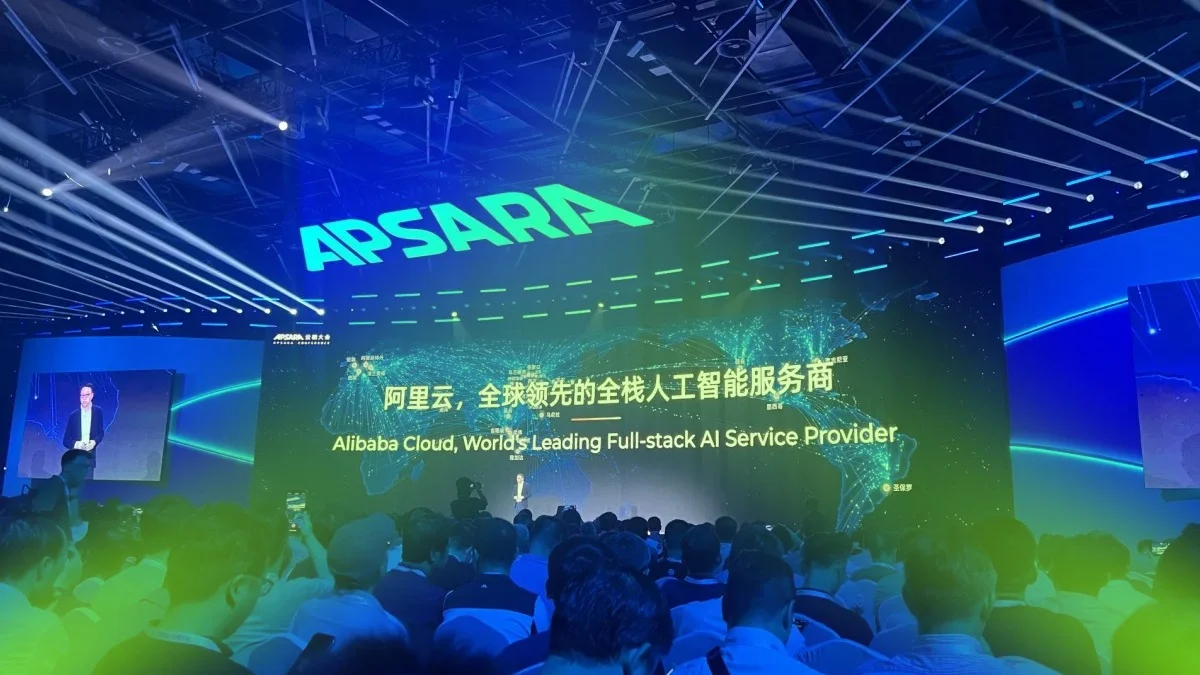
Reports of a breakthrough in Alibaba’s in-house chipmaking spurred interest in the computing hall, though the rumored PPU chip wasn’t shown. Visitors instead saw the Panjiu AI Infra 2.0 server, which can hold 128 chips per rack.
State-backed giants such as China Mobile, State Grid, and ZTE were also present. ZTE’s Song Teng noted: “Previously, it was the big internet companies and the government that needed data centres and computing clusters. Now it’s becoming increasingly common for small and medium-sized enterprises to need compute – to deploy AI models for instance.”
National Ambitions and Global Reach
Beijing wants AI to grow into a US$100 billion industry by 2030, with intelligent agent adoption above 90 percent. Its “AI Plus” plan stresses the role of open source in spreading AI technology.
At Apsara, Alibaba showcased its full suite of Qwen models, including its biggest yet, Qwen3-Max. Zhao Yuze from Alibaba-backed ModelScope stressed the need for recognition abroad: “Our country is now very technically advanced at AI, yet many developers and applications are not getting the praise they deserve overseas.” ModelScope launched an international version this week to address that.
On Friday, AI benchmark firm Artificial Intelligence named Qwen3-Max the most powerful non-reasoning model in the world, across both open-source and proprietary categories.
ALSO READ: Honor Teases Magic 8 Series With Snapdragon 8 Elite Gen 5