


Nostalgia is no longer the only reason to purchase flip phones; they are now flagship devices in the 2026 mobile phone market, with competition between Samsung and Motorola heating up significantly.
Samsung has always maintained the largest portion of premium flip phones (Galaxy Z Flip Series). However, Motorola has been building a following through the Razr series, which has now officially surpassed 50% of the US foldable market (according to reports). With the launch of the Razr 70 Ultra, Motorola seems poised to take on Samsung directly for the first time in this space.
Ultimately, the major question is: should you spend your money on the Razr 70 Ultra or the Galaxy Z Flip 7?
Motorola Razr 70 Ultra vs Samsung Galaxy Z Flip 7: Key Differences
Check out this article to compare both devices side-by-side and discover which one will be most useful for your everyday life.
| Feature | Motorola Razr 70 Ultra | Samsung Galaxy Z Flip 7 |
| Starting Price | £1199 / $1499 | £1049 / $1099 |
| Processor | Snapdragon 8 Elite | Exynos 2500 |
| Main Display | 6.96-inch, 165Hz, 5000 nits | 6.9-inch, 120Hz, 2600 nits |
| Cover Display | 4-inch, full app support | 4.1-inch |
| Battery | 5000mAh | 4300mAh |
| Wired Charging | 68W | 25W |
| Wireless Charging | 30W | 10W |
| Cameras | Triple 50MP setup | 50MP + 12MP + 10MP |
| Software Updates | 3 OS updates | 7 years OS + security |
| Weight | 199g | 188g |
| Thickness (unfolded) | 7.19mm | 6.5mm |
| Design Style | Bold, premium finishes | Minimal and industrial |
Design
When it comes to folding phones, both the Motorola Razr 70 Ultra and Samsung Galaxy Z Flip 7 have distinct styles and personalities.
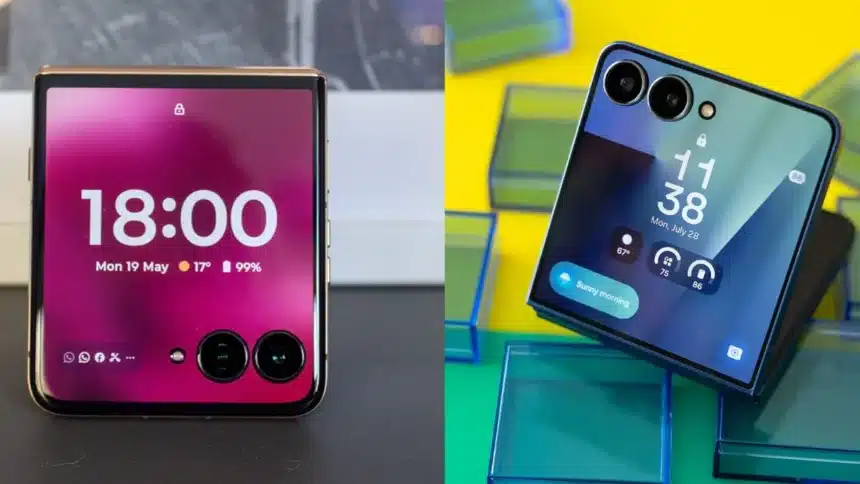
The Motorola Razr is heavily influenced by design with its selection of Pantone-certified colours, the Alcantara finish on some models, and the option of a wood veneer back.
There is no question that the Razr looks like a totally different device compared to another glass rectangular device that has been made to look modern. This is especially important as you spend top dollar for a Flip phone, so you want to be able to show it off.
On the other hand, Samsung is playing it safe by continuing its metal frame, glass body design with the Z Flip 7. While the finish is still smooth and somewhat industrial-looking, it is less exciting. For pure functionality, Samsung wins.
The Z Flip 7 is thinner and lighter than the Razr. At 188 grams, it is easier to carry, easier to hold for a long time, and fits better into your pocket. Samsung’s hinge design also appears to be slightly better designed than that of the Razr.
Display
On paper, Motorola dominates here.
The Razr 70 Ultra packs brighter displays, higher refresh rates, and sharper resolution on both the inner and outer screens. The 5000 nits peak brightness is especially important outdoors because foldables can sometimes struggle under harsh sunlight.
The difference becomes noticeable while watching HDR videos or using the phone outside during daytime.
Motorola’s outer display also feels more useful. You can properly run apps on it without feeling restricted. It behaves almost like a mini Android phone, which genuinely improves the flip-phone experience.
Samsung’s cover display is technically a bit larger, but the software still feels more controlled and less open compared to Motorola’s.
That said, Samsung’s crease handling remains slightly cleaner. The crease is visible on both phones, but Motorola’s fold line stands out a little more during use.
Still, for overall display quality and usability, Motorola takes this round comfortably.
Performance and Battery
If raw hardware matters to you, the Razr 70 Ultra is the stronger phone.
Motorola is using Qualcomm’s Snapdragon 8 Elite chip, while Samsung has gone with the Exynos 2500. Even though Samsung’s chip isn’t weak by any means, Qualcomm still carries stronger trust among power users and gamers.
Day-to-day performance should feel smooth on both devices, but the Razr has more headroom for multitasking, gaming, and long-term performance stability.
Battery is another major difference.
A 5000mAh battery inside a flip phone is honestly impressive. Samsung’s 4300mAh battery suddenly feels small in comparison.
Then there’s charging.
Motorola’s 68W wired charging and 30W wireless charging absolutely destroy Samsung’s 25W and 10W setup. The difference in real-world usage is huge. The Razr can top up much faster during busy days, especially for people constantly travelling or working outdoors.
This is one area where Samsung genuinely feels behind.
Cameras
While Samsung has always been the company leading the charge in the world of smartphone cameras, it appears as though Motorola is making a concerted effort to catch up with its newly released device, the Razr 70 Ultra. It contains a camera setup with a staggering three 50MP cameras: main, ultra-wide and selfie.
Samsung has decided to remain on the sidelines for the time being, continuing to rely on only one 12MP ultra-wide and one 10MP selfie sensor for its flagship Galaxy S21 Ultra phone.
Motorola also has a brand new LOFIC sensor technology, which promises better dynamic range as well as improved low-light capabilities than what has been available in previous models. If the software optimisation can hold up its end of the deal, this could be one of the best flip phone camera setups we have seen thus far in history.
Samsung still has some advantages with regard to consistency. Not only does Samsung have years of experience refining its foldable camera systems, but the FlexCam and AI Auto Zoom features each provide genuine value and utility for content creators and people taking selfies.
However, in terms of pure hardware, it appears as if Motorola has set itself up to be more prepared for the future than Samsung has.
Software
This is where things get complicated for Motorola.
The Razr 70 Ultra may have better hardware, but Samsung still offers a better long-term ownership experience.
Samsung promises seven years of OS and security updates. Motorola is only offering three Android updates.
For a phone costing this much, that’s difficult to justify.
Motorola’s Hello UI also continues to divide opinions. The software now includes more AI features, extra apps, recommendations, and interface clutter compared to older Motorola phones that were loved for their near-stock Android experience.
Samsung’s One UI is heavy too, but it feels more polished and mature now. Galaxy AI features are better integrated, and Samsung’s ecosystem support remains stronger overall.
If you plan to keep your phone for four to six years, Samsung is the safer investment.
So, Which Flip Phone Should You Buy?
The answer depends on what kind of user you are.
Buy the Motorola Razr 70 Ultra if:
- You want the most powerful flip phone hardware
- Battery life and fast charging matter a lot
- You care about unique design and premium materials
- You want a better outer screen experience
- You love brighter and punchier displays
Buy the Samsung Galaxy Z Flip 7 if:
- You want longer software support
- You prefer slimmer and lighter phones
- You trust Samsung’s foldable experience more
- You want a more stable software ecosystem
- You’re looking for better value for money
Right now, the Razr 70 Ultra feels like the more exciting phone. Motorola finally feels confident again, and that confidence shows in the hardware choices. It’s bold, powerful, and actually different in a market where most flagship phones look identical.
But Samsung still understands longevity better than almost anyone in Android.
And honestly, that seven-year software support promise is hard to ignore when you’re spending over $1000 on a foldable.
Also Read: Samsung Galaxy S26 Ultra vs Motorola – Which Horizon Lock Feature Actually Wins?