


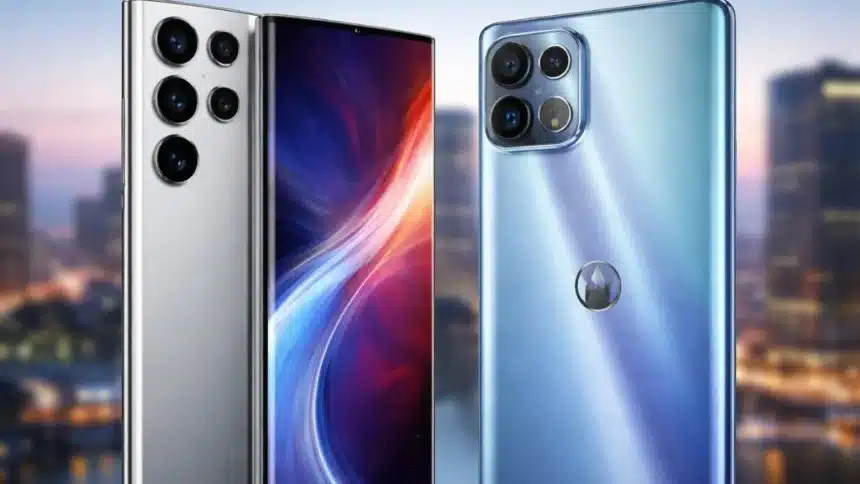
Samsung’s new Horizon Lock feature on the Galaxy S26 Ultra has everyone talking about how great it will be for capturing smooth videos while in motion and how much this will benefit video creators.
But the catch is that thanks to the Moto Z family of phones, Motorola launched their own version of Horizon Lock back in 2019 and gave it to users of all Motorola LTE-capable smartphones, not just those at the ultra-premium end of the spectrum.
So, now if both phones have the same opinion, which one works best? Let’s compare them both according to their features.
How Horizon Lock actually works
On both Samsung and Motorola devices, the concept is nearly identical. The phone combines footage from the main and ultrawide cameras, then uses AI, along with gyroscope and motion sensors, to keep the frame level.
You can rotate your phone mid-recording, and the video stays steady. No tilt, no awkward angles.
This is especially useful while shooting on the move, like in a car, on a bike, or even while walking.
Samsung vs Motorola: Where the difference shows
On paper, both deliver the same feature. In reality, the difference is in execution.
The Galaxy S26 Ultra pushes better resolution and maintains clarity even with stabilization turned on. Motorola offers wider access across devices, but quality depends heavily on the model.
| Feature | Samsung Galaxy S26 Ultra | Motorola Phones |
| First Introduced | Recently (S26 series) | As early as 2019 |
| Availability | Premium flagship only | Available across mid-range & flagship |
| Video Quality | Higher, more consistent | Drops on cheaper models |
| Resolution | Up to QHD in Horizon Lock | Typically capped at 1080p |
| Stabilization | Cleaner edges, less distortion | Slight fringing in some cases |
| Camera Use | Main + ultrawide fusion | Same approach |
| Extra Controls | Standard | Some models offer orientation lock |
| Value for Money | Expensive but polished | More accessible across price points |
Motorola brings flexibility. Features like orientation lock on select devices add convenience, especially for casual creators. Whereas Samsung keeps things tighter but focuses on refinement. The output looks cleaner, especially in challenging movement or lighting.
So, who actually wins?
If you want the best-looking video, the Galaxy S26 Ultra wins. It handles motion better and keeps footage sharp.
But Motorola still holds its ground by making the feature widely available and introducing it much earlier.
Also Read: Edit Like Hollywood! DaVinci Resolve’s Colour Grading Tool Now Supports Photos for Free