




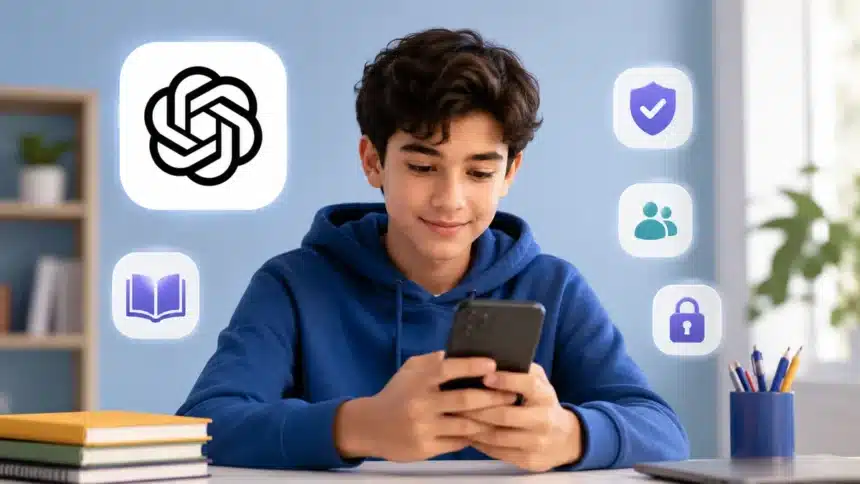
On August 18, 2026, OpenAI released ChatGPT for Teens. This version of ChatGPT was created especially for users between the ages of 13 and 17. It has more robust safety features, learning-oriented tools, and parental restrictions that are activated by default. This is all the information parents and teenagers need to understand how it functions, what it alters, and what it actually entails.
What Is ChatGPT for Teens?
With an experience tailored for younger users, ChatGPT for Teens is the same powerful ChatGPT that adults utilize. It is neither a stand-alone program nor a simplified version. The entire ChatGPT feature set for learning, creating, and idea exploration is still available to teenagers. The distinction is that usage reminders, study aids, and age-appropriate safeguards are integrated from the outset.
- What Is ChatGPT for Teens?
- What’s New in ChatGPT for Teens?
- Can ChatGPT for Teens Help With Homework?
- What Safety Protections Does ChatGPT for Teens Have?
- What Can Parents Control in ChatGPT for Teens?
- Can Parents Read Their Teen’s ChatGPT Conversations?
- How Does ChatGPT for Teens Encourage Healthy AI Use?
- Can Teens Still Customize ChatGPT?
- Why Are Safety Protections Stronger for ChatGPT for Teens?
- What Should Parents Know Before Their Teen Uses ChatGPT?
- What Happens When a Teen Turns 18?
- Final Takeaway
The adolescent experience automatically kicks in if a user’s account shows they are between 13 and 17 or if OpenAI’s age-prediction technology determines they are under 18. There is no setting to locate or toggle to flip. It simply occurs.
According to OpenAI’s established age guideline, children under the age of 13 are not allowed to use ChatGPT at all.
On August 18, 2026, the rollout for qualified teen accounts on both free and paid personal ChatGPT plans started worldwide. By September 8, full availability in Australia is anticipated.
What’s New in ChatGPT for Teens?
While ChatGPT for Teens unifies everything under one roof and adds a number of new features, OpenAI has already delivered certain youth-focused features over the past year (parental controls and study mode launched around a year ago, and age-prediction tools rolled out earlier in 2026).
The main characteristics are broken down as follows:
| Feature | What It Does | Why It Matters |
| Teen-specific onboarding | Guides new users through learning, creative, and daily usage tools and settings. | Helps teenagers grasp the capabilities of the instrument and how to utilize it sensibly right away. |
| Study mode and study hours | Offers hints, step-by-step guidance, follow-up questions, and knowledge checks; study hours let teens or parents schedule when new chats start in study mode. | Encourages active learning instead of passive answer-copying. |
| Responsible homework reminders | Detects when a teen appears to be shortcutting an assignment and redirects them to study mode. | Reduces the temptation to use ChatGPT as a cheat tool. |
| Quizzes and learning tools | Provides practice questions and comprehension checks. | Helps teens test their understanding rather than just reading answers. |
| Break reminders | Periodically reminds teens to take breaks and clarifies that ChatGPT is an AI tool. | Discourages overuse and emotional overreliance. |
| Image upload reminders | Prompts teens to check for sensitive information before sharing an image. | Protects privacy and reduces impulsive sharing. |
| Content safeguards (default on) | Restricts graphic violence, self-harm content, sexual or romantic roleplay, and other sensitive material. | Reduces exposure to developmentally inappropriate content without requiring any setup. |
| Quiet hours | Blocks access to ChatGPT during scheduled times (set by parent or teen). | Supports healthy screen-time boundaries. |
| Safety notifications | Alerts a linked parent or guardian in limited high-risk situations. | Gives parents a safety net without constant surveillance. |
The simplified adolescent onboarding process, the image upload prompts, and the responsible homework reminders are new features that weren’t there before. Instead of requiring parents to locate and activate protections, everything else has been streamlined and combined to make them apply automatically.
Can ChatGPT for Teens Help With Homework?
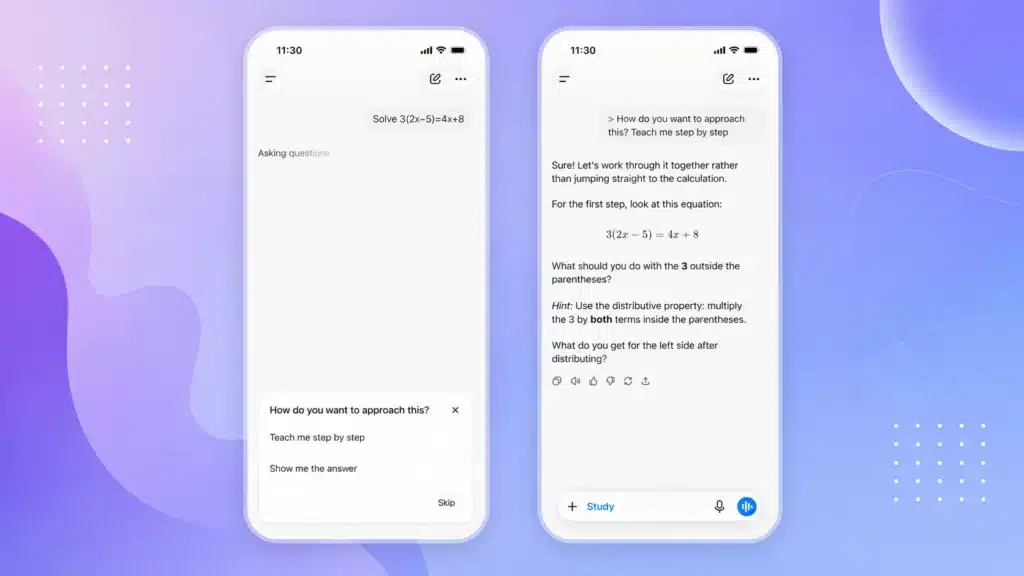
Yes, but not in the way that some teenagers would like. The purpose of ChatGPT for Teens is to avoid giving out simple solutions. Rather, it takes pupils step-by-step through issues.
When an adolescent requests assistance with an assignment, the system can provide suggestions, pose follow-up queries, or advise them to work through a topic before disclosing the solution. The system can switch a teen to study mode if it notices that they are attempting to get around an assignment (for instance, by putting in an essay prompt and requesting a completed essay).
You can arrange study mode as well. Teens or their connected parents can choose “study hours,” at which time any new chat will automatically switch to study mode. Access to ChatGPT is not completely blocked by this. During certain windows, it only modifies the default behavior.
As part of the teen experience, OpenAI also provides learning visuals and quizzes, allowing students to practice and assess their comprehension of the subject matter.
The practical conclusion is that while ChatGPT for Teens is helpful as an instructor and study partner, it is purposefully less helpful as a shortcut machine.
What Safety Protections Does ChatGPT for Teens Have?
ChatGPT for Teens’ safety features are on by default. They don’t need to be activated by parents. They include:
- Content restrictions around suicide, self-harm, graphic violence, and sexual or romantic content.
- Blocking romantic or sexual roleplay
- Preventing the chatbot from implying it has feelings, is conscious, or experiences emotions toward the user.
- Surfacing warnings and safety information around sensitive topics like eating disorders.
- Routing sensitive conversations to reasoning models that can handle them more carefully.
- Reducing exposure to developmentally inappropriate material across all interactions.
These safeguards are based on what OpenAI refers to as its “U18 Principles,” which emphasize early intervention, prevention, and openness and are anchored in developmental research.
The chatbot won’t pose as an emotional companion, romantic partner, or friend. According to Allison Mishkin, head of child development at OpenAI, the team intentionally deleted signs that would cause an adolescent to form an unhealthy relationship to the AI.
This is significant because, according to a 2025 Common Sense Media survey, 72% of teens have used AI companions, while 52% use them regularly.
What Can Parents Control in ChatGPT for Teens?
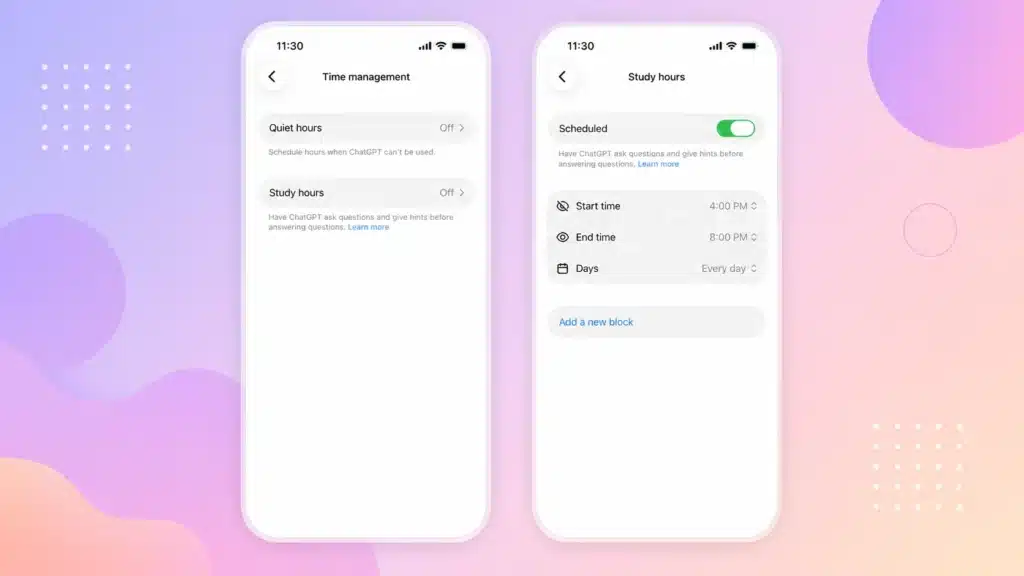
Parental controls are optional and require both the teen and the parent or guardian to opt-in. Once linked, parents can manage the following:
| Parent Control | What It Does |
| Quiet hours | Blocks the teen’s access to ChatGPT during scheduled times (for example, overnight or during school hours) |
| Study hours | Sets specific times when any new chat automatically starts in study mode |
| Safety notifications | Sends an alert to the parent in limited high-risk situations, such as when the system flags a possible risk of self-harm. |
| Reduce sensitive content | Manages the level of content filtering applied to the teen’s account |
Important: The purpose of parental controls is to supplement, not to replace, the built-in safeguards. According to Ann O’Leary, Vice President of Global Policy at OpenAI, the objective is to “make sure that this is safe, even if you don’t use parental controls.”
The opt-in requirement means teens retain some agency. A parent cannot unilaterally impose controls without the teen’s participation in the linking process.
Can Parents Read Their Teen’s ChatGPT Conversations?
No. This is stated clearly in OpenAI’s official documentation. Parental controls do not let a parent or guardian read or monitor a teen’s conversations.
If OpenAI sends a safety notification (for example, if the system flags a possible risk of self-harm), it shares only the minimum information needed to help support the teen’s safety. It does not share transcripts, chat logs, or conversation details.
This is a purposeful design decision. It strikes a compromise between parental knowledge and teen privacy, providing parents with a safety net in dire circumstances without transforming the tool into a surveillance system.
How Does ChatGPT for Teens Encourage Healthy AI Use?
Beyond content restrictions, ChatGPT for Teens includes several features aimed at building good habits:
- Break reminders appear periodically, encouraging teens to step away from the screen.
- AI transparency reminders make it clear that ChatGPT is a tool, not a person.
- No emotional mimicry means the chatbot will not pretend to care about the user, have feelings, or simulate a relationship.
- Image upload prompts ask teens to pause and think before sharing photos.
- Learning-focused starter prompts guide teens toward productive uses when they open a new chat.
The overall philosophy is to treat teens as capable users who deserve access to powerful tools, while acknowledging that their brains are still developing and they benefit from guardrails that adults may not need.
OpenAI CEO Sam Altman has described “emotional overreliance” on AI as a “really common thing” among young people. These features are a direct response to that concern.
Can Teens Still Customize ChatGPT?
Yes. ChatGPT for Teens includes customization options such as accent colors and voice variations. Teens can personalize the look and feel of their experience.
However, customization does not extend to removing safety protections. A teen cannot turn off content restrictions, disable homework reminders, or opt out of the age-appropriate safeguards. Those remain in place regardless of any personalization choices.
The experience is still the same capable ChatGPT. Teens can use it for creative projects, everyday questions, brainstorming, and exploration. The guardrails shape how the tool responds, not what it can be used for in general.
Why Are Safety Protections Stronger for ChatGPT for Teens?
The short answer: because the risks are real and documented.
Research from a watchdog group found that ChatGPT previously would tell 13-year olds how to get drunk and high, instruct them on concealing eating disorders, and compose suicide letters if asked. While the system typically warned against risky activity, it would then go on to provide detailed, personalized plans for drug use, calorie-restricted diets, or self-injury.
Multiple lawsuits have been filed against OpenAI over allegations that ChatGPT provided harmful content to minors, including a case involving a California teen who died by suicide. In June 2026, the Florida Attorney General sued OpenAI for failing to warn the public about ChatGPT’s dangers to young users.
Teenagers’ brains are not fully developed, particularly the prefrontal cortex responsible for impulse control and long-term decision-making. They are more susceptible to anthropomorphizing AI, developing emotional attachments to chatbots, and acting on impulsive requests without considering consequences.
ChatGPT for Teens exists because the standard adult experience was not designed with these vulnerabilities in mind, and the consequences of that gap became impossible to ignore.
What Should Parents Know Before Their Teen Uses ChatGPT?
A few practical points worth understanding:
- It activates automatically. If your teen already has a ChatGPT account and is identified as under 18, they will be moved into the teen experience without needing to do anything.
- Parental controls are optional but recommended. The built-in protections work without them, but linking your account gives you access to quiet hours, study hours, and safety notifications.
- Both parties must opt in. You cannot set up parental controls without your teen’s participation.
- It is not just for schoolwork. Teens can use ChatGPT for creative projects, everyday questions, and general exploration. The protections apply across all uses.
- No tool is perfect. OpenAI uses age assurance (a combination of self-reported age, behavioral signals, and verification) to identify minors, but it does not verify ages with government ID by default. If the system cannot determine age, it defaults to the safer setting.
- About 70% of teens say their teachers have not talked to them about using AI safely, according to a survey by the Youth AI Safety Institute at Common Sense Media. Parents may need to fill that gap.
What Happens When a Teen Turns 18?
An account may automatically leave ChatGPT for Teens if ChatGPT determines that the user is 18 years of age or older. Teen safeguards and any associated parental restrictions may be eliminated as a result.
On a certain birthday, the transfer is neither guaranteed nor instantaneous. Depending on account details or age verification, it depends on when the system detects the age change.
Certain safeguards (such as limiting sensitive content or parental controls) can be restored at any time if the user so desires when the account switches to the usual adult experience. However, they will no longer be used by default.
A user can confirm their age to have the adolescent protections removed if they are 18 years of age or older and were inadvertently placed in the teen experience (for instance, because of age prediction).
Final Takeaway
ChatGPT for Teens isn’t a compromised product. It is the same potent AI tool, but it has an extra layer of security for users whose minds and judgment are still maturing. The learning tools promote active thinking over passive copying, the safeguards are activated by default, and the parental settings provide a surveillance-free safety net.
The most crucial thing for parents to know is that this experience is triggered automatically for kids who have been recognized. It doesn’t need to be set up. However, using parental controls to link your account provides you with other features like safety alerts and quiet hours, which are worth investigating.
The technology is still really helpful for learning, creating, and concept exploration for teenagers. Simply said, it won’t assist you in cheating, posing as a buddy, or viewing inappropriate content.
It is a significant advancement. It remains to be seen if it is sufficient.