



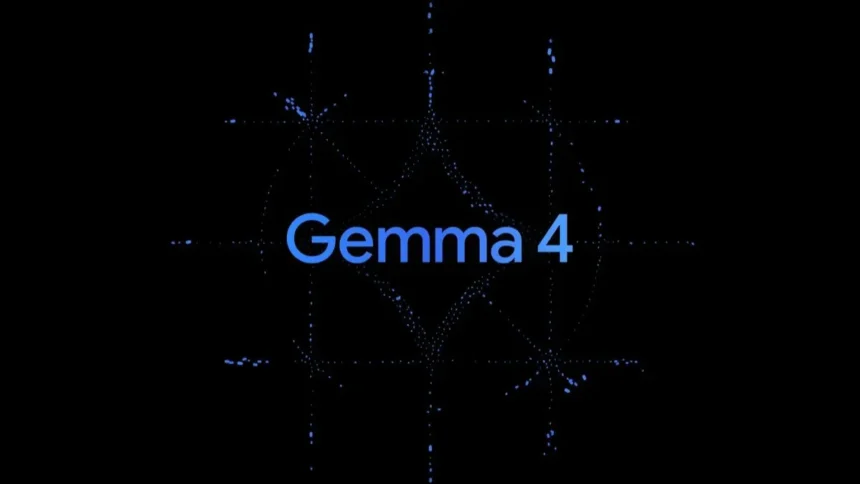
Google has introduced its latest Gemma 4 AI models with open-weight licensing under Apache 2.0. The objective of this significant change in licensing is to provide developers with greater freedom and control over model usage.
Within the Gemma 4 lineup are four different model types, designed for local hardware (computers). The largest two models are designed for heavy-duty, high-powered setups. They include the 26B model, a mixture of experts, and the 31B dense model.
On the opposite end of the extreme are the two models, known as the effective 2B model and the 4B model, which are specifically tuned for smartphone and edge device applications.
Google says that, in addition to having performance gains, much greater usability has also been incorporated into these new models.
For example, the new 26B model can be configured to use only a small percentage of its parameters during inference to speed up responsiveness.
The 31B model will be optimally used for fine-tuning applications as it will create output that is of higher quality than the other models.
Focus on speed, efficiency and real-world use
For mobile and edge computing, the E2B and E4B models are designed to run with lower memory usage and near-zero latency. Google confirmed that its Pixel team collaborated with chipset makers like Qualcomm and MediaTek to ensure these models perform efficiently on devices such as smartphones and compact systems.
Under the hood, Gemma 4 is built on the same core technology as Google’s Gemini models, bringing improvements in reasoning, mathematics and instruction-following. It also supports newer AI workflows, including native function calling, structured JSON outputs and integration with tools and APIs.
Code, vision and offline capabilities
Code generation and visual processing are also key focus areas. Google claims developers can generate high-quality code locally using Gemma 4, reducing reliance on cloud-based systems. The models are also better at handling tasks like OCR and chart analysis, while smaller variants include improved speech recognition capabilities.
Apache 2.0 shift addresses developer concerns
One of the biggest changes is the licensing move. Previous Gemma models used a custom Google license that many developers found restrictive. With Gemma 4, Google has shifted to the widely used Apache 2.0 license, which allows more freedom in commercial use and removes stricter compliance requirements.
The move is expected to make Gemma more appealing to developers who were hesitant to build on earlier versions due to licensing concerns.
The release also signals what’s next for on-device AI. Google confirmed that its upcoming Gemini Nano 4, expected to power future smartphone features, will be based on the smaller Gemma 4 models.
Also Read: Apple Drops Urgent iOS Patch for Those Who Skipped iOS 26 – Update Now!