




Most people buying a phone in 2026 are stuck choosing between two things: a phone that is lightweight and sleek, or a phone that actually has good hardware inside it.
For a long time, these two things did not come together. If you wanted a compact phone, you accepted a smaller battery, a weaker chip, and a bit of low-quality cameras, and if you wanted a proper flagship, hardware, camera and more, you needed to bear the weight of the phone.
Vivo has been quietly trying to fix this problem with its FE (Fan Edition) lineup. The Vivo X300 FE is the latest release. It packs a flagship processor, a 6500mAh battery, and a 50MP dual-lens camera system, everything inside one body, that measures around 6.31 inches.
This has now put Vivo under the same size bracket as the iPhone 17 and Samsung Galaxy S26 base models.
Quick Specs Summary
Let’s first have a look at the basic specifications of the Vivo X300 FE:
| Feature | Detail |
| Display | 6.31-inch LTPO AMOLED, 120Hz, 5000 nits |
| Processor | Snapdragon 8 Gen 5 |
| RAM / Storage | 12GB + 256GB / 512GB |
| Main Camera | 50MP Sony IMX921, f/1.57, OIS |
| Telephoto | 50MP Sony IMX882, 3x optical zoom, OIS |
| Ultra-Wide | 8MP |
| Front Camera | 50MP with autofocus |
| Video | 8K@30fps, 4K@120fps |
| Battery | 6500mAh |
| Wired Charging | 90W |
| Wireless Charging | 40W |
| OS | OriginOS 6 (Android 16) |
| Water Resistance | IP68 / IP69 |
| Weight | 190g |
| Price | From ~$730 (256GB) / ~$929 (512GB) |
Price
The Vivo X300 FE starts at around $730 for the 12GB + 256GB variant and goes up to approximately $929 for the 12GB + 512GB model. European pricing sits at €899 for the 512GB version.
The phone is not officially sold in the US or UK. It is available in selected European markets, including Spain, Austria, Hungary, and Poland, as well as India, the UAE, Saudi Arabia, Brazil, South Korea, and other Asian markets.
Pricing can vary between regions, so it is worth checking availability through local Vivo retailers or authorised resellers.
Design
The Vivo X300 FE is built to be used with one hand. That is the whole point of the compact size, and Vivo has not cut corners to get there.
The phone measures 150.8 x 71.7 x 7.99mm and weighs 190 grams. That weight is roughly the same as a standard flagship, but because the screen is smaller, it distributes better in your hand.
The back panel uses glass with a metal frame. The phone comes in three colour options, Moonlight White, Cool Purple, and Graphite Black globally.
One thing worth knowing about the camera placement is that the lenses are arranged in a horizontal bar that runs across the top of the back panel. The bump is minimal, so the phone sits flat on a table.
The phone is rated IP68 and IP69 for dust and water resistance, which means it can handle full submersion in water as well as high-pressure water jets.
Display
The Vivo X300 FE has a 6.31-inch AMOLED display with a resolution of 2640 x 1216 pixels, a 1Hz to 120Hz LTPO refresh rate, and up to 5000 nits of local peak brightness.
To put that brightness number in context, most phones sit between 1000 and 2000 nits for typical outdoor use. 5000 nits means the screen stays readable even in direct afternoon sunlight.
The LTPO panel is worth paying attention to. It means the display can automatically lower its refresh rate to 1Hz when showing a static image. This directly saves battery without you having to do anything.
The 120Hz refresh rate applies to everyday scrolling and app use, which makes the phone feel noticeably smoother than displays stuck at 60Hz.
Processor and Performance
The Vivo X300 FE runs on the Snapdragon 8 Gen 5 chip, paired with LPDDR5X Ultra RAM and UFS 4.1 storage.
The Snapdragon 8 Gen 5 is Qualcomm’s mainstream flagship chip for 2025-26. It handles everything from heavy multitasking to gaming without slowdown. The UFS 4.1 storage is also the fastest storage standard currently available on Android phones, which means apps open quickly and file transfers are fast.
The phone comes in configurations of 12GB RAM with either 256GB or 512GB storage.
Camera
The camera section is where the Vivo X300 FE has a lot to offer you.
Rear Cameras
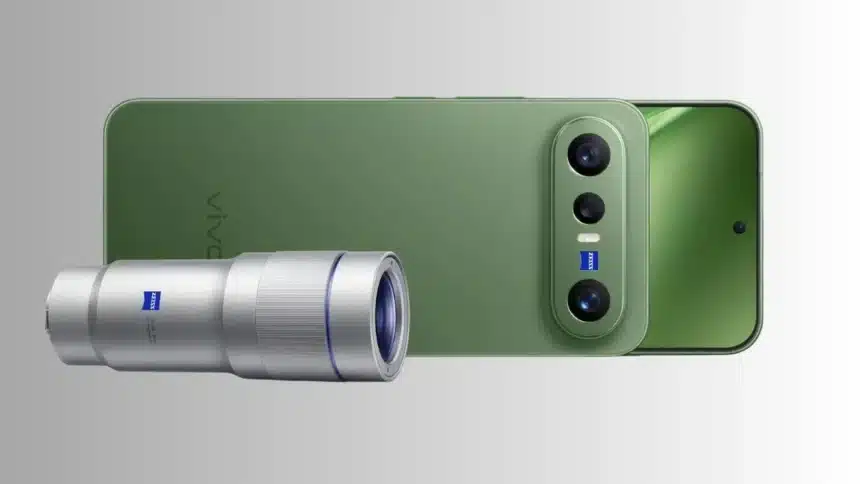
The back of the phone has three cameras: a 50MP Sony IMX921 main camera with OIS, an 8MP ultra-wide lens, and a 50MP Sony IMX882 periscope telephoto camera with 3x optical zoom and OIS.
The two Sony sensors on the main and telephoto cameras are the same ones used in much more expensive phones. Both have optical image stabilisation (OIS), which reduces blur when shooting handheld, especially in low light or when using zoom.
The main camera has a wide f/1.57 aperture. A wider aperture means more light enters the sensor, which directly improves low-light photography.
The one genuine weak spot is the 8MP ultra-wide. It has a small sensor, no autofocus, and it struggles at night. If wide-angle shots are something you use a lot, this is worth knowing.
Front Camera
The selfie camera is a 50MP sensor with autofocus. The autofocus is the important detail here, because most front cameras use fixed focus, which means you have to be a specific distance from the phone for sharp results. With autofocus, the camera adjusts regardless of where you are holding it.
Battery and Charging
The Vivo X300 FE houses a 6500mAh battery with 90W wired charging and 40W wireless charging support.
6500mAh is an unusually large battery for a 6.31-inch phone. Most compact flagships in this size class sit between 4000 and 5000mAh.
With 90W wired charging, the phone goes from empty to full in roughly 35 minutes. The 40W wireless charging means you can place it on a compatible wireless pad overnight without needing to plug in a cable at all.
Software
The phone runs OriginOS 6 based on Android 16 out of the box. Vivo has committed to 5 years of major Android OS updates and 7 years of security patches for this model.
That means the phone will continue to receive software updates until at least 2031-2033, which is a meaningful commitment for a phone at this price.
Also Read: Huawei Watch Kids X1 Series: Features, Safety Tools, And Specifications