

Every morning, millions of people strap a mini computer to their wrists. They charge it alongside their phones, glance at it when it buzzes with endless group chat notifications, and try to ignore the slight panic that sets in when the battery icon turns red at 3:00 PM. We have been sold a vision of health tracking that requires maximum digital overhead, high price tags, and a constant tether to a wall outlet.
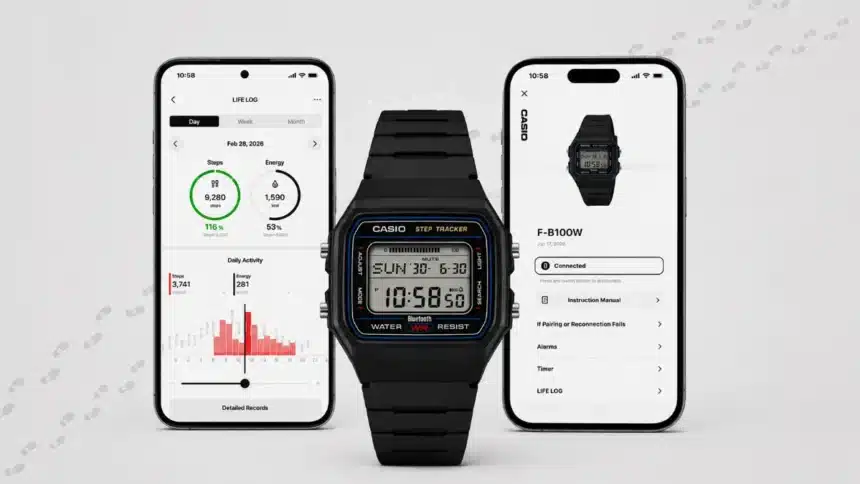
The Casio F-B100W seems to offer a refreshing counter-argument to that approach. With its simple digital design and focus on essential features, the watch takes a different path from today’s increasingly complex smartwatches.
- The Fatigue of the Modern Smartwatch Experience
- Enter the Casio F-B100W: Less Is Finely Tuned
- Why a Two-Year Battery Changes Everything
- A User’s Perspective: Why Simple Health Tracking Works Better
- Comparing the Approaches: Full Smartwatch vs. Minimalist Tracker
- The Case for Purpose-Built Objects
- Practical Utility Wins in the Long Run
With the introduction of the F-B100W, the Japanese watchmaker has taken its iconic retro silhouette and retrofitted it with modern step tracking, Bluetooth connectivity, and a battery life measured in years rather than hours. All of this comes wrapped in an unassuming resin package priced at roughly £55.
For anyone who feels exhausted by the complexity of modern smartwatches, this release feels less like an entry-level tech accessory and more like a gentle reality check for the entire wearables industry.
The Fatigue of the Modern Smartwatch Experience
To understand why a basic digital watch with a built-in step counter feels so appealing right now, it helps to look at what smartwatches have actually become.
When modern fitness wearables first hit the market, the promise was simple: track your activity, stay informed, and improve your daily health. Over time, that simple premise morphed into an arms race of feature creep. Today’s flagship smartwatches are incredible technical achievements, but they are also relentless attention hogs.
The Problem With Constant Connectivity
- The Notification Flood: Having wrist-based vibrations for every email, news alert, and text message quickly transitions from convenient to overwhelming.
- Charging Anxiety: A device that needs to sit on a magnetic puck every single night breaks the seamless habit loop of wearing a timepiece.
- Feature Overkill: Most everyday users only end up using two core functions: checking the time and keeping tabs on their movement.
- Financial Strain: Paying $400 or more for a gadget with a non-replaceable battery that degrades in three to four years feels like an unsustainable subscription model for telling time.
For a large segment of watch wearers, the modern smartwatch experience feels less like wearing a helpful tool and more like managing an additional digital chore.
Enter the Casio F-B100W: Less Is Finely Tuned
Casio is no stranger to functional minimalism. The brand built its reputation on indestructible, ultra-reliable timepieces that do their jobs without pretense. The F-B100W builds directly on that legacy, drawing clear aesthetic inspiration from classic models like the beloved F-91W.
On the surface, it looks like a standard retro digital watch. It features a lightweight rectangular resin case, a clear LCD panel, traditional side pushers, and a modest profile that sits comfortably under a shirt sleeve. However, tucked inside this classic casing is a modern accelerometer designed to track daily physical activity.
What the F-B100W Actually Offers
Rather than trying to turn your wrist into a phone screen, Casio stripped fitness tracking down to its absolute essentials:
- Integrated Step Counter: An internal accelerometer logs daily steps and displays progress directly on the primary LCD face.
- Activity Graphing: A subtle visual indicator on the display shows activity distribution throughout the day, providing at-a-glance motivation without bright animations.
- Bluetooth Syncing: The watch connects to Casio’s companion smartphone app to log step history, configure settings, adjust world time, and execute automatic time synchronization.
- Essential Timekeeping Tools: Built-in stopwatch capabilities with up to 200 lap records, a countdown timer, five daily alarms, and a phone finder feature.
- Multi-Year Power: Operates on a standard replaceable CR2016 coin battery rated to last approximately two years under normal use.
Why a Two-Year Battery Changes Everything
The single most meaningful feature of this watch is not the step counter itself, but the way it is powered.
Smartwatches from major tech brands have conditioned consumers to accept daily or alternate-day charging as an unavoidable compromise. If you forget to charge your device overnight, your health tracking for the following day is effectively broken. If you go away for a weekend without a proprietary cable, your watch becomes a dead weight on your arm.
| Device Category | Typical Battery Life | Charging Requirement |
| Flagship Smartwatches | 18 to 36 Hours | Daily / Proprietary Dock |
| Advanced Sport Watches | 7 to 14 Days | Weekly / Custom Cable |
| Casio F-B100W | ~2 Years (24 Months) | Replaceable CR2016 Cell |
By opting for an energy-efficient liquid crystal display and omitting power-hungry components like full-color OLED screens, continuous optical heart rate monitors, and active GPS receivers, Casio restored the fundamental benefit of a regular wristwatch: you put it on, and you forget about it.
Wearing a device for two full years without ever thinking about a charging cable restores a level of friction-free utility that high-end smartwatches simply cannot match.
A User’s Perspective: Why Simple Health Tracking Works Better
From a practical, everyday viewpoint, there is a strong psychological argument to be made for simpler tools.
When a fitness tracker attempts to measure heart rate variability, oxygen saturation, sleep stages, skin temperature, and stress levels, it often creates a paradox of information overload. Users can become hyper-fixated on health scores, constantly checking their wrists for validation or worrying about minor fluctuations in metrics they cannot directly control.
The Intentional Simplicity of Step Counting
Step tracking remains one of the most effective, easy-to-understand metrics for general movement. It requires no complex interpretation:
- Clear Directives: Walking 8,000 or 10,000 steps a day is an intuitive goal that anyone can visualize.
- Low Friction: You do not need to initiate a specific workout mode or categorize your activity before going for a walk.
- No Distractions: Without buzzing wrist notifications or endless menu navigation, the watch stays out of your mental space until you actively choose to look at it.
For someone whose primary fitness goal is simply moving more throughout the day, spending $400 on a high-end device filled with unused sensors is a massive mismatch of tools to needs.
Comparing the Approaches: Full Smartwatch vs. Minimalist Tracker
To appreciate where the F-B100W fits into the current landscape, it helps to contrast the core user experience against a conventional flagship smartwatch.
| Feature / Aspect | Conventional High-End Smartwatch | Casio F-B100W |
| Price Point | $350 – $800 | Approximately £55 (~$70) |
| Primary Display | High-resolution color touchscreen | Monochrome LCD |
| Battery Duration | 1 to 2 days | Approximately 2 years |
| Primary Focus | Full smartphone extension & deep telemetry | Accurate timekeeping & basic activity tracking |
| Notifications | Calls, texts, app alerts, interactive replies | Silent or audible daily alarms |
| Weight & Wearability | Moderate to heavy; requires snug fit for sensors | Featherweight (26 grams, 8.8mm thickness) |
| Long-Term Durability | Battery degrades over 3-4 years | Fresh coin cell restores full operational life |
The Case for Purpose-Built Objects
There is a growing quiet movement toward single-purpose and low-friction technology. People are recognizing that consolidating every aspect of digital life into a single device on the body is not always ideal.
Casio’s design philosophy with the F-B100W respects the wearer’s attention. It does not demand that you establish a daily charging routine. It does not interrupt your conversations with social media pings. It does not attempt to analyze your sleep architecture or tell you how recovered you are for the day.
Instead, it functions as a reliable, durable timekeeper that casually keeps count of your strides while sitting weightlessly on your wrist.
Practical Utility Wins in the Long Run
High-tech wearables will always have their place. Athletes training for endurance events, individuals monitoring specific medical metrics, and tech enthusiasts who genuinely love wrist-based computing will continue to buy full-featured smartwatches.
However, for the vast majority of people who simply want to stay somewhat active, make sure they are not sitting at a desk all afternoon, and know what time it is, the arms race of high-end wearables has become unnecessary.
Casio has demonstrated that thoughtful design and extreme utility do not require cutting-edge screens or massive price tags. By sticking to what it does best, durable, affordable, ultra-reliable timepieces, and adding just enough modern technology to fulfill a clear need, the Japanese manufacturer has provided a compelling alternative to the expensive smartwatch ecosystem.
You do not need a $400 computer strapped to your arm to live a healthier life. Sometimes, all you need is an honest digital watch that keeps accurate time, stays powered for years, and counts your steps along the way.