




Cameras on smartphones can now see farther than optical zoom lenses in pockets thanks to a clever trick that uses bent light. Here’s how periscope zoom works, why it’s important, and where the tech stands right now.
The Problem It Solves
Physics is stubborn. A long focal length is needed for optical zoom to work, and a long lens is needed for a long focal length. The barrel sticks out on a dedicated camera, but no one complains. A regular telephoto lens that is tall enough to give you a 5x or 10x optical reach will not fit on a smartphone that is less than 9 mm thick. For years, companies lied about it with digital zoom, which cropped the sensor and moved pixels around. The results got worse very quickly. Anything bigger than 3x looked like a watercolor. The business world needed a real optical answer that wouldn’t turn every flagship phone into a camera brick.
How the Mechanism Works
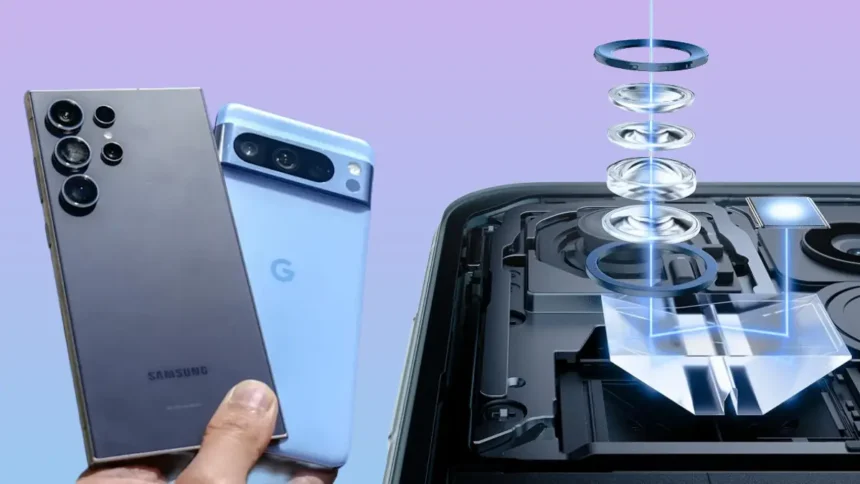
The optical axis of a periscope camera can be turned to solve the space problem. The lens stack in a normal telephoto camera points straight out of the phone. Light moves in a straight line from the outside world to the sensor through the lens. When a prism or mirror is placed at a 45-degree angle, it bends light coming in by 90 degrees and sends it along the body of the phone in a horizontal direction. When they are done, the lens elements and sensor are lined up next to the back glass instead of across from it.
The focal length is no longer limited by how thick the phone is. It can only go as wide as it is now, which gives it a lot more room. The lens stack fits inside the chassis so well that it can’t be seen. It would normally stick out a few centimeters. This lets the camera optically zoom in 5x, 10x, or even more without making a big difference.
Prism, Mirror, and Apple’s Tetraprism
Most periscopes only have one prism, which bends light only once. Light is bounced four times inside a small prism assembly before it gets to the sensor. Apple’s tetraprism was first used in the iPhone 15 Pro Max and has been improved since then.
The extra reflections make the optical path longer while keeping the size of the footprint the same. This means that the 5x zoom can fit into the same iPhone body.
In 2026, prism-based designs will be the norm for top-of-the-line phones because they last longer, stay stable at different temperatures, and stay aligned better over the life of the phone than mirrors. More often than not, mirror designs break when hit or vibrated. They are lighter and cost less to make.
Stabilisation Inside a Bent Light Path
It’s not easy to keep a periscope camera stable. The optical image stabilization we use today moves a sensor or lens element to the side to stop handshake. It is harder to use that method on an optical path that is folded without messing up how the whole assembly is lined up.
To keep the folding part stable, the prism or mirror must be tilted by very small amounts of a degree at a time. Before light gets to the rest of the lens stack, this stops shaking where the light comes in. With this method, called fold-element OIS, stabilization is as good as or better than with main cameras. It’s now what all periscope modules from Apple, Google, Xiaomi, Samsung, and Apple use.
Zoom Ranges in the Real World
Your periscope lens’s optical zoom is most likely between 3x and 10x. After that, everything is done digitally, but by 2026, AI upscaling will be good enough that 20x or 30x zoom will look useful instead of clearly shaky. By putting together several frames and using sensor-shift processing to bring back small details, the Google Pixel 9 Pro raised Super Res Zoom to 30x. Apple starts at 5x optical and goes all the way up to 25x computational. There were optical anchors at both 3x and 10x on the S23 Ultra and S25 Ultra, which were made by Samsung. This let you zoom in and out without any loss of quality at two different distances.
The 2026 Shift: Samsung Goes Conventional
The most interesting thing that happened in 2026 was that Samsung took the periscope off of the Galaxy S26 Ultra’s 5x telephoto lens. A normal straight-axis lens with an aperture of f/2.9 is in the new periscope, not the old one. This lets in about 38% more light and makes the blurred background smoother and rounder.
It was found by Samsung that the periscope’s shape made it harder to see in low light more than it helped see farther.
The trade-off is real: the minimum focusing distance grew, which made it harder to take close-up telephoto pictures of things like bugs, food, and product details. Various manufacturers had various thoughts on what was going on. In 2026, both Xiaomi and Vivo kept making their periscope designs better. The difference in low light that kept Samsung ahead shrunk a lot when telephoto sensor sizes reached 1/1.4-inch.
Limitations Still Worth Knowing
Cameras on periscopes always have trouble. The field of view is narrow when the focal length is long, which makes it hard to follow moving things. The prism geometry makes the backgrounds that aren’t in focus have angular bokeh, which means they have straight lines instead of smooth circles of blur. One reason why Samsung’s standard design looks better up close is because of this. Some high-end smartphones have periscope modules, but not many. This is because they are pricey and hard to make, as they need more parts and tighter tolerances than any other camera in the phone.
What Comes Next
Continuous variable optical zoom is the next big thing. This means that the lens elements inside the periscope stack move so that you get a real zoom range instead of a fixed focal length with digital fill in between stops. In 2027, a number of businesses plan to make things that use this technology. The company Oppo showed off early models in the Find X line. In the other direction, sensor size goes up or down. As telephoto sensors get bigger and closer to 1/1.3-inch, the difference between the main camera and the periscope telephoto in low light and dynamic range keeps getting smaller. It would have been crazy to think five years ago that the best telephoto frames on a flagship phone in 2026 could compete with dedicated mirrorless lenses at the same focal lengths.
The Verdict
As far as consumer electronics go, the periscope telephoto zoom is one of the most beautiful engineering ideas ever. There is a hard physical limit that is turned sideways so things that shouldn’t fit inside a 9mm device can. It is mature enough for serious photography now (in 2026) and powerful enough to compete with separate cameras at telephoto distances. It is also still changing.
The main idea is still the same: light that is bent can go where straight light can’t. This is still true even with bigger sensors, focal lengths that can be changed, or improvements to the prism itself.