





Take a PS5 controller and press a trigger in the middle of a game. It’s loose sometimes. It will sometimes push back against your finger, making you feel like you’re drawing a bowstring.
There is no wear on that controller. That’s adaptive triggers and haptic feedback working together. These are two technologies that let your controller talk to your hands as well as your eyes and ears. We’ve made this short summary easy to read by skimming it.
The Two-Second Definition
Haptic feedback means smarter, more accurate vibrations that can imitate texture and impact (for example, rain on gravel vs. a footstep).
Adaptive triggers have a motor inside them that changes how hard you have to pull them, and the game controls this in real time.
Since they came out at the same time on Sony’s DualSense in late 2020, they are often thought of as a single feature. Their goals are different, so they’re not the same.
What is Haptic Feedback?
In the earlier days, rumble used one or two motors to spin an off-centre weight. Explosions, gunfire, and footsteps all felt about the same.
These days, haptics use actuators that can do:
- Sharp, localized hits, like a gunshot or a punch.
- Rolling vibrations that feel like an engine idling and distant thunder.
- Different sensations, like rain on a roof, footsteps on gravel, and ice in a glass.
The difference is precision. Instead of just making a buzz, developers can time these feelings to exact moments on-screen.
How Adaptive Triggers Actually Work
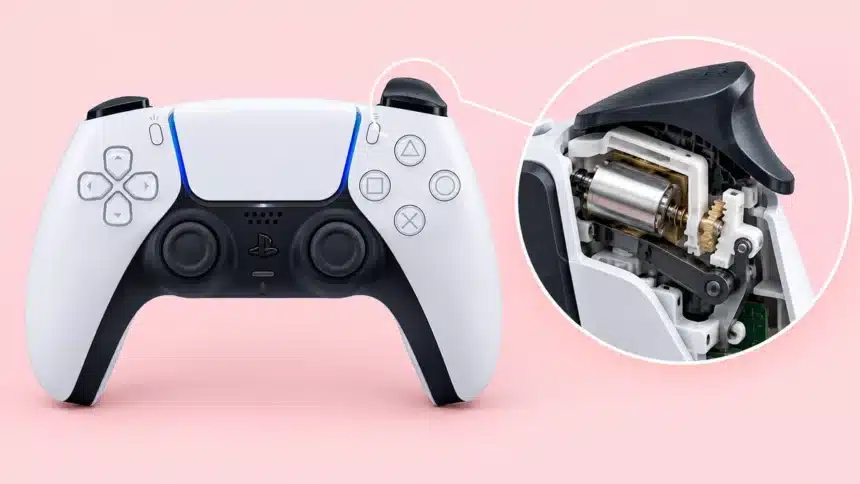
This is the part that most explainers skip over: it’s not just smart software; it’s a real mechanical system.
1. The trigger normally acts like any other analog trigger
Inside each trigger is a worm gear, a lever, a geared wheel, and a small DC motor. When the resistance mechanism is inactive, the trigger operates normally. The lever stays out of the way.
2. The game sends a resistance command
When the game needs it, like when you need to draw a bow or pull out a stuck weapon, the controller’s chip spins the motor, which moves the worm gear into place.
3. The lever moves into the trigger’s path
Now, to pull the trigger, you have to push against the geared mechanism that the lever is holding in place. That’s the resistance you feel in your finger.
4. Resistance is programmable, not just on/off
It can be applied in different ways across the trigger pull, allowing developers to simulate effects such as increasing bow tension, weapon trigger resistance, or braking force.
Where This Actually Works (And Where It Doesn’t)
Here’s what surprises people. Support varies depending on the game, controller, platform, and connection.
| Setup | Does it work? |
| PS5 DualSense / DualSense Edge, Sony first-party games | Yes, in supported titles. Games like Astro Bot, Horizon Forbidden West, and Death Stranding 2 use DualSense features extensively. |
| PS5 DualSense, third-party PS5 games | Depends on the game. Some third-party titles make extensive use of adaptive triggers and haptic feedback, while others use them more lightly. |
| DualSense on PC | Supported in select PC games. Feature support varies by title and connection; USB is required for haptic feedback and may be required for adaptive triggers in some games. |
| DualSense on PC with Steam Input enabled | Depends on the game. Steam Input supports DualSense remapping, while native DualSense features such as adaptive triggers and haptics depend on the game’s implementation. |
| Third-party PS5 controllers (Razer, SCUF, Victrix, Nacon, etc.) | Varies by controller. Some, including SCUF Reflex and Reflex Pro, support adaptive triggers, while controllers such as the Nacon Revolution 5 Pro do not. |
| Xbox / Switch controllers | They do not use DualSense-style adaptive triggers. Xbox’s “Impulse Triggers” use dedicated vibration motors in the triggers rather than variable mechanical resistance. |
The PC Trade-Off, Explained
The DualSense may not expose all of its advanced features when you plug it into a PC. Here’s why:
- Game support matters: Adaptive triggers and haptic feedback work in select PC games that explicitly support DualSense features.
- Steam Input can change how the controller is handled: Some games support native DualSense features alongside Steam Input, while others may require Steam Input to be disabled for those features to work as intended.
- The workaround can have a cost: If a game requires you to turn off Steam Input to use its native DualSense implementation, you can lose Steam Input-specific remapping or gyro configurations.
- Wired is still important here: Sony says a USB connection is required for haptic feedback in PC games and may be required for adaptive triggers in select games.
If you’re comparing controllers for different gaming setups, Devicology’s guide to the best mobile controllers for cloud gaming also explains how wired and Bluetooth controller connections differ.
Does It Wear Out Faster?
That’s a good question. A motor and gears are more complicated than a simple spring, and things with more moving parts can introduce additional points of mechanical failure.
- Sony doesn’t publish official failure-rate data for the adaptive trigger mechanism.
- Adaptive trigger mechanisms can develop faults, but there is no reliable evidence establishing that they typically become stiff or fail after a specific one- or two-year period.
- The trigger assemblies inside a standard DualSense can be repaired or replaced by technicians, but they are not user-swappable modules. The DualSense Edge’s officially replaceable modules are its stick modules, not its adaptive trigger assemblies.
Why Any of This Actually Matters
It would be easy to dismiss this as a novelty, but it does something truly new:
- It gives developers a third way to talk to players, beyond sound and sight.
- If your weapon jams, the trigger can resist or lock before the warning fully registers visually.
- You can feel a car losing its grip through trigger or haptic feedback before you can fully see it on screen.
- Tension in a horror game can be shown through vibrations alone, without a single word spoken.
With touch as its own design language and not just an add-on to the screen, that’s a different kind of feedback loop than traditional rumble controllers offered.
Where Will You Feel It Most
This tech doesn’t work equally well for all types of games. A few stand out:
- When drawing a bow or slingshot, progressive resistance is the best way to show how it works.
- Accelerator or brake resistance can simulate braking force or other driving effects in real time in racing games.
- In shooters, a gun that jams or has a staged trigger pull makes the mechanics feel more real.
- In horror and atmosphere-based games, small haptic pulses that feel like a heartbeat can build tension without using any sound effects.
The best feeling is one that matches what your hands would feel in real life.
Conclusion
Two technologies, adaptive triggers and haptic feedback, work together. Adaptive triggers use a motor-driven mechanism to physically resist your finger, and haptic feedback uses precise vibration to simulate texture and impact. Together, they let a controller talk to you through touch as well as sound and sight. Unfortunately, this experience is still limited. It’s most closely associated with Sony’s DualSense hardware, support varies on PC, and the adaptive trigger system is mechanically more complex than a conventional trigger. But when it works right, it’s one of the best examples of a controller using touch to add another layer to gameplay.