




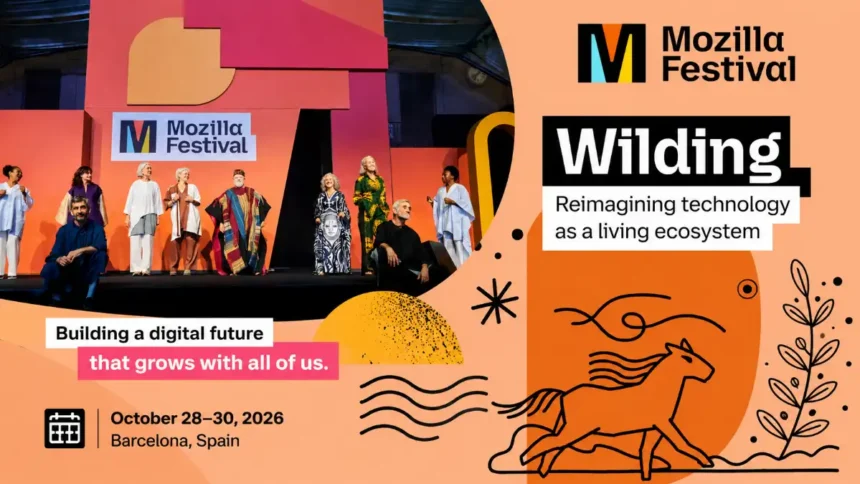
Mozilla Festival 2026 centers on a powerful idea: Wilding. The theme asks what happens when we loosen the rigid systems that currently shape technology so communities and tools can evolve more naturally, much like plants finding their way through cracked pavement.
This is not abstract philosophy. It is a practical invitation to rethink how we design, build, and govern the digital world. Instead of treating technology as a fortress controlled by a few large platforms, the festival imagines it as a grove: open, adaptive, plural, and regenerative.
Mozilla Festival 2026 will take place in Barcelona from October 28-30, 2026, with the festival being co-created by its global community.
A Director’s Personal Root System
Zeina Abi Assy, Director of MozFest, grounds the theme in her own life. Raised in Lebanon between journalism and farming lineages, she watched her father treat engineering and land care as parts of the same circular practice. Building a water system or tending an olive grove both required attention to mutual impact. Life itself often revolved around olive season, a shared rhythm that marked the end of summer and the start of fall.
Her mother’s side carried memory of land that could not always be visited. Stories of walnut trees, figs, and resilience became a form of imaginative technology when physical access was cut off. Those stories kept a place alive even when borders and conflict made it distant.
In 2026, while visiting family, geopolitical tension created a sense of paralysis. Morning walks offered a different image: wildflowers still blooming across a country that has endured years of hardship. Those flowers became a living metaphor. They pushed through difficult conditions with a quiet insistence on life. Wilding takes that same impulse and applies it to the systems we inhabit online and offline.
Wilding is active. It is not a passive frame for desk-bound discussion. It asks what it would mean to build technology that expands the conditions for life rather than narrowing them. A wilded technology does not wait for permission from a single owner. It seeds, spreads, and adapts to the people who tend it. It favors interoperability over walls, plurality over a single flattened profile, and regeneration over extraction.
What Wilding Looks Like in Practice
People are already doing this work in many places. Their efforts resemble wildflowers appearing in unexpected spots:
- Communities creating their own datasets and systems in their own languages
- Activists designing digital safety infrastructure that fits local realities
- Journalists building open-source tools that run on public records rather than corporate clouds
- Indigenous groups developing and owning their own communication networks
- Technologists creating anti-surveillance tools and refusing to let their work fuel conflict
These projects are resilient because they grow from lived needs rather than top-down scale or profit motives. Mozilla Festival aims to become a gathering place for such efforts, a temporary garden of different intelligences, forms of power, and possible futures.
Community co-curators echo this view. Irene Mwendwa notes that information itself is wild and can develop across many kinds of infrastructure, opening space to advocate for women’s and girls’ autonomy in knowledge sharing. Sarah Al-Yahya describes the wildflower as the effort to carve out agency in restrictive spaces, whether by reworking source material or studying how others do the same. Habib Sheidu points to community-led civic technology that emerges organically, stays adaptive, and stays rooted in people’s actual conditions.
Why This Theme Matters Now
Much of today’s technology concentrates control. A small number of platforms shape what people see, how data moves, and whose voices travel farthest. The result often feels extractive and brittle. Wilding offers a different design language: one that values openness, mutual care, and the capacity to regenerate.
The festival does not claim that technology can simply be returned to some pure natural state. Instead, it treats the current moment as an opportunity to choose differently. Design choices can either reinforce walls or create pathways for more life. The central question is straightforward: what would it mean to build tools that widen possibilities rather than shrink them?
Resources for Going Deeper
Mozilla has gathered starting points for anyone who wants to arrive at the festival already thinking in these terms. The list mixes literature, journalism, and on-the-ground practice.
Selected books include works that explore relationship, land, strategy, and living systems:
- Braiding Sweetgrass and Gathering Moss by Robin Wall Kimmerer
- Emergent Strategy by adrienne maree brown
- Sand Talk by Tyson Yunkaporta
- Entangled Life by Merlin Sheldrake
- Parable of the Sower by Octavia E. Butler
- A River Dies of Thirst by Mahmoud Darwish
- Sea and Fog by Etel Adnan
Key articles include “We Need To Rewild The Internet” by Maria Farrell and Robin Berjon, Robin Wall Kimmerer’s “Corn Tastes Better on the Honor System,” and conversations around ecological approaches to technology.
Local and community organizations on the list focus on regenerative farming, seed saving, herbal knowledge, and Indigenous networks. They range from Soul Fire Farm and Speakeasy Farm to the Palestine Heirloom Seed Library, Asia Indigenous Peoples Pact, and various cooperatives that treat soil and community knowledge as connected forms of infrastructure.
These references are not required reading. They simply offer pathways into the same questions the festival is asking.
Looking Ahead
Mozilla Festival 2026 will bring people together around sessions, workshops, and conversations shaped by this theme. The festival is scheduled for October 28-30, 2026, in Barcelona, Spain, and its program is being shaped through community participation.
Past and ongoing Mozilla work already points in related directions, from efforts that examine AI and democracy to projects that make invisible systems more visible. The festival’s eight community-designed tracks include Wilding Advocacy, Wilding Knowledge, Wilding Systems, Wilding With Nature, Youth Wilding, Wilding Creativity, Founders Wilding and Developers Wilding.
The festival itself is framed as an experiment in collective tending. Participants are invited not only to critique existing systems but to practice the kind of building that feels more like cultivation than conquest. The goal is not perfection. It is the deliberate creation of conditions in which more life, more agency, and more forms of intelligence can take root.
Wilding does not promise easy answers. It does offer a different posture: less fortress, more grove. Less extraction, more regeneration. Less single-owner control, more shared stewardship. For anyone who has felt the weight of rigid digital systems, the theme provides both a diagnosis and an invitation to start planting something else.
Badges for Mozilla Festival 2026 are already available through the official festival website. The gathering will test whether a large community event can itself function as a temporary wild garden, one that seeds ideas people can carry home and continue tending long after the festival ends.