





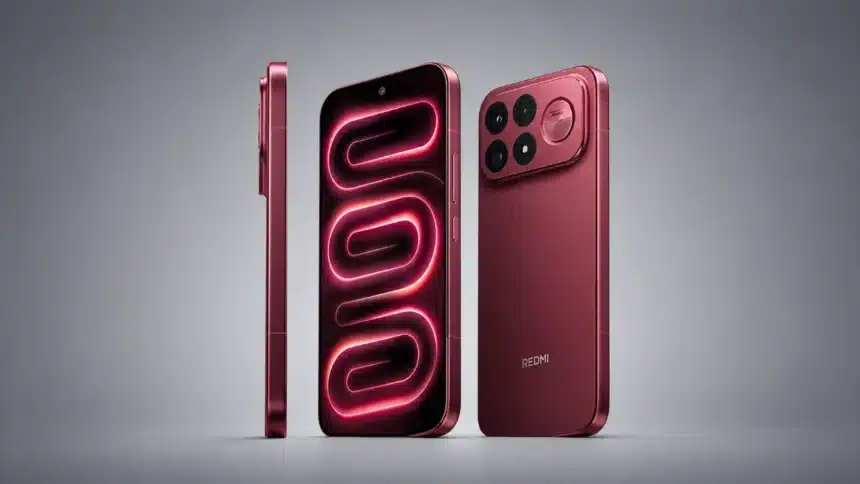
Xiaomi just pushed its Redmi K-series into genuine ultra-premium territory with the Redmi K100 Pro Max. The phone launched in China on August 11, 2026, and went on sale with first-sale promotions that reduced the starting price from CNY 4,499 to CNY 4,199. This is not a modest upgrade. It is one of the most technically aggressive smartphones Xiaomi has put under the Redmi name, combining a flagship Snapdragon platform, a 185Hz display, a 9,070mAh battery, a 200MP camera system, and Bose-tuned 2.1-channel audio.
Raw Power Under the Hood
At the center sits Qualcomm’s Snapdragon 8 Elite Gen 5, built on a 3nm process. The full-core version used in the Pro Max is paired with Xiaomi’s dedicated AI Game Display Chip D2, which is designed to improve gaming visuals and frame stability through functions such as super-resolution and frame interpolation.
The phone also uses a 6,300mm² ice-sealed circulating cooling pump to help manage heat during sustained workloads. A coordinated hardware and software scheduling system is designed to keep performance stable under heavy gaming and other demanding tasks.
Memory options climb as high as 16GB of LPDDR5X Ultra RAM and 1TB of UFS 4.1 storage, giving the phone plenty of capacity for large game libraries, applications, and media files.
A Display Built for Intensity
The Redmi K100 Pro Max carries a 6.9-inch flat OLED display using M11 luminous material and Xiaomi’s Super Pixel technology with a full RGB lossless pixel arrangement. It reaches a maximum 185Hz refresh rate, with 480Hz touch sampling and up to 4,800Hz instantaneous touch sampling.
Peak local brightness reaches 4,500 nits in a 25% window, while Xiaomi also lists up to 10,000 nits in a 1% local peak measurement. Minimum brightness drops to 1 nit. The panel supports 10-bit colour depth and covers 90% of the BT.2020 colour gamut.
Xiaomi also highlights its Qingshan Eye Protection 4.0 system, along with full-brightness DC dimming and circularly polarised light technology. A 3D ultrasonic fingerprint sensor is included for biometric authentication.
Battery That Refuses to Quit
Inside sits Xiaomi’s 9,070mAh Jinshajiang battery, one of the largest capacities currently offered in a flagship smartphone. Charging is handled by Xiaomi’s Surge P3 fast-charging chip and Surge G2 battery-management system.
Wired charging reaches 100W, while wireless charging reaches 50W. Reverse charging is rated at 27W wired and 22.5W wireless. The phone also supports bypass charging, which can help reduce battery heat during sustained gaming by powering the device more directly.
Camera System Aimed at Creators
The main camera uses a 200MP Samsung HP5 sensor with a 1/1.56-inch optical format and optical image stabilisation. It is joined by a 50MP periscope telephoto camera with 5x optical zoom and a 50MP ultra-wide camera. The front camera is 32MP.
The periscope telephoto camera supports up to 100x digital zoom. Xiaomi’s camera system is therefore designed to cover a wide range of shooting scenarios, from standard photography to long-distance subjects and ultra-wide compositions.
The phone also supports advanced camera functions and professional shooting controls, while video recording reaches up to 8K at 30fps according to current specification listings.
Sound and Connectivity That Match the Rest
Audio is handled by a 2.1-channel speaker system featuring two 1115D master-grade full-range speakers and a dedicated 1620 subwoofer. The system is tuned in collaboration with Bose, with the design focused on stronger low frequencies and a more immersive audio experience. The phone also supports Dolby Atmos and Hi-Res audio technologies.
Connectivity sits at the current flagship level:
- Wi-Fi 7
- Bluetooth 6.0
- Dual-SIM 5G
- USB 3.2 Gen 1 with up to 5Gbps transfer speeds
- NFC and infrared remote control
- Full GNSS support
- X-axis linear motor
- 3D ultrasonic fingerprint sensor
The Redmi K100 Pro Max also carries IP66, IP68 and IP69 dust and water resistance ratings. The phone measures 8.45mm thick and weighs 238g, with a glass-fibre rear panel and a metal frame.
Why This Phone Matters
The Redmi K100 Pro Max is Xiaomi’s clearest statement yet that the K-series can compete at the absolute top of the Android market. It combines extreme display performance, a 9,070mAh battery that still supports fast wired and wireless charging, a versatile 200MP camera system, and dedicated gaming hardware in one package.
The launch pricing also makes the phone particularly aggressive in China. The Redmi K100 Pro Max starts at CNY 4,499, while its first-sale price was CNY 4,199 for the 12GB + 256GB version. The top 16GB + 1TB configuration is priced at CNY 5,999, with first-sale pricing also available.
For users who prioritize smooth high-refresh gaming, long battery life under load, detailed photography, and large-screen media consumption, the Redmi K100 Pro Max arrives as one of the most complete flagship options Xiaomi has offered under the Redmi brand.
Visit Devicology for the latest Tech News, Guides, and in-depth Reviews. Follow us on Whatsapp, LinkedIn, X (Twitter) and Instagram to never miss an update!