





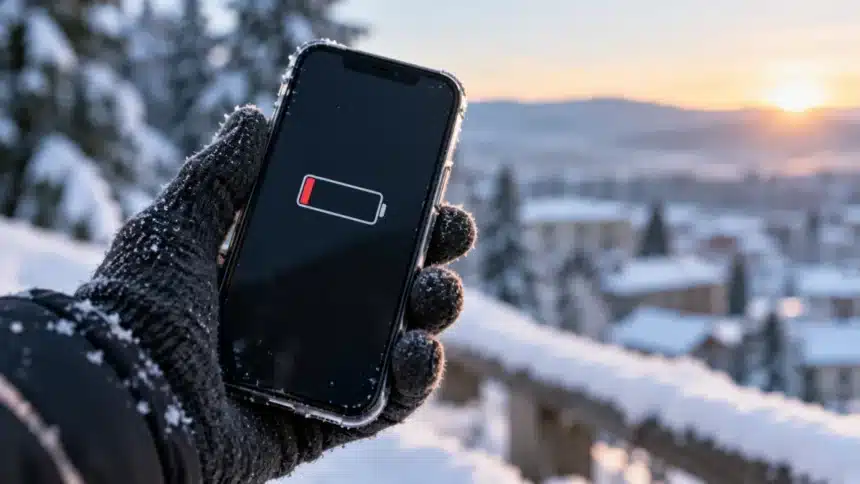
You step outside on a freezing winter morning, check your phone, and notice everything seems normal.
Twenty minutes later, your battery has dropped from 45% to 18%.
- The Winter Battery Mystery
- Your Battery Runs on Chemical Reactions
- Cold Doesn’t Actually “Steal” Your Battery
- Why the Battery Percentage Drops So Quickly
- Why Phones Sometimes Shut Down With Battery Left
- Why Taking Photos Makes It Worse
- The Real Danger Isn’t Using Your Phone
- Why Older Phones Struggle More
- How to Keep Your Battery Alive in Winter
- A Quick Myth Worth Debunking
- Closing Statement
Maybe it shuts down entirely.
Maybe it suddenly jumps back to 30% once you’re indoors.
At first, it feels like your phone is malfunctioning. But if you’ve ever experienced this during a cold day, you’re seeing one of the most common side effects of lithium-ion battery technology.
The good news? Your phone usually isn’t broken.
The bad news? Your battery and winter weather have never been close friends.
The Winter Battery Mystery
Almost every smartphone owner has experienced some version of this:
- Battery percentages falling unusually fast outdoors
- Unexpected shutdowns despite charge remaining
- Slower charging speeds
- Performance drops in very cold conditions
What’s especially frustrating is that the battery often appears to “recover” after warming up.
That behavior seems impossible.
How can a phone die at 20% and then come back to life half an hour later?
The answer lies in battery chemistry.
Your Battery Runs on Chemical Reactions
Modern smartphones use lithium-ion batteries.
Inside those batteries, lithium ions move between electrodes to store and release energy. The entire process depends on chemical reactions occurring efficiently. When temperatures drop, those reactions slow down significantly, making it harder for the battery to deliver power.
Think of it like running through waist-deep water.
You can still move.
You just can’t move as easily or as quickly.
That’s essentially what’s happening inside your battery.
Cold Doesn’t Actually “Steal” Your Battery
One of the biggest misconceptions is that cold weather destroys battery charge.
That’s usually not what’s happening.
Instead, low temperatures temporarily reduce the battery’s ability to deliver power effectively. Many battery experts note that performance often improves after the device warms back up to normal temperatures.
The energy is still there.
Your phone just has trouble accessing it.
A useful analogy is a bottle of maple syrup.
At room temperature, it pours effortlessly.
Put it in the refrigerator, and it becomes thick and sluggish.
The syrup hasn’t disappeared.
It’s simply harder to use.
Why the Battery Percentage Drops So Quickly
What makes cold weather especially confusing is the way battery percentages behave.
Most people assume the percentage displayed on the screen is a perfect measurement of remaining energy.
It isn’t.
Your phone estimates battery levels using factors that include voltage and current delivery.
In cold temperatures, battery voltage can temporarily drop. The phone interprets this as lower available charge and adjusts the battery percentage accordingly.
That’s why you may see:
| Situation | What You See |
| Indoors at 70°F | 50% battery |
| Outside at 20°F | 25% battery |
| Back indoors | 40% battery |
It feels like battery percentages are being invented on the fly.
In a sense, they are being recalculated based on changing conditions.
Why Phones Sometimes Shut Down With Battery Left
Perhaps the most alarming winter behavior is a sudden shutdown.
You look at your screen and see:
- 30% battery remaining
- 25% battery remaining
- Sometimes even lower
Then the phone powers off.
This typically happens because cold temperatures increase internal resistance and reduce voltage under load. When power delivery drops below what the phone requires, the device may shut down to protect itself, even though chemical energy remains in the battery.
In other words, the battery isn’t necessarily empty.
It’s temporarily unable to provide enough power.
Why Taking Photos Makes It Worse
Ever notice your phone struggles most when using:
- The camera
- GPS navigation
- Video recording
- Mobile gaming
- Video calls
That’s not a coincidence.
These activities demand more power.
During cold weather, the battery is already struggling to deliver energy efficiently. High-demand apps increase the load, making voltage drops more likely and accelerating visible battery drain.
The result?
Your battery seems to fall off a cliff exactly when you need it most.
The Real Danger Isn’t Using Your Phone
Here’s where many people worry unnecessarily.
Using a phone in cold weather is usually not what causes long-term problems.
Charging it while extremely cold is often a bigger concern.
Some battery experts note that charging lithium-ion batteries at very low temperatures can contribute to battery damage through chemical processes that are less likely under normal conditions.
That’s why many devices automatically slow or limit charging when temperatures fall too far. Apple explains that iPhone charging may slow down or pause in cold conditions.
Why Older Phones Struggle More
If your phone is three or four years old, winter can feel especially brutal.
Older batteries already have:
- Reduced capacity
- Increased internal resistance
- More wear from charge cycles
Cold weather amplifies those weaknesses.
That explains why a newer phone might survive a winter commute comfortably while an older device starts shutting down halfway through the trip.
How to Keep Your Battery Alive in Winter
The goal isn’t to keep your phone warm like a houseplant.
But a few simple habits can make a noticeable difference.
Keep It Close to Your Body
An inside jacket pocket is often much better than:
- An outside pocket
- A backpack
- A purse exposed to cold air
Body heat helps keep the battery within a healthier operating range.
Use a Power Saving Mode
Reducing power demand helps compensate for reduced battery efficiency.
This is especially useful during long outdoor activities.
Avoid Leaving It in the Car
A freezing car can expose devices to temperatures far below what most smartphones prefer.
Warm It Gradually
If your phone becomes extremely cold, let it return to room temperature naturally.
Avoid placing it near direct heat sources.
A Quick Myth Worth Debunking
Many people assume cold weather permanently damages a healthy battery every time they step outside.
That’s not generally true.
Most cold-weather battery loss is temporary and improves once the device warms up again. The battery’s performance may appear dramatically reduced in the cold, but much of that capacity typically returns under normal temperatures.
Heat, ironically, is often a bigger long-term threat to battery lifespan than cold.
Closing Statement
If your phone battery seems to disappear faster during winter, you’re not imagining things. Cold weather slows the chemical reactions inside lithium-ion batteries, increases internal resistance, and temporarily reduces the battery’s ability to deliver power efficiently.
That’s why battery percentages can plunge unexpectedly, phones can shut down with charge remaining, and performance often returns once the device warms up.
The next time your phone goes from 40% to panic mode during a cold morning walk, remember: your battery probably isn’t dying.
It’s just cold, grumpy, and waiting for spring.