




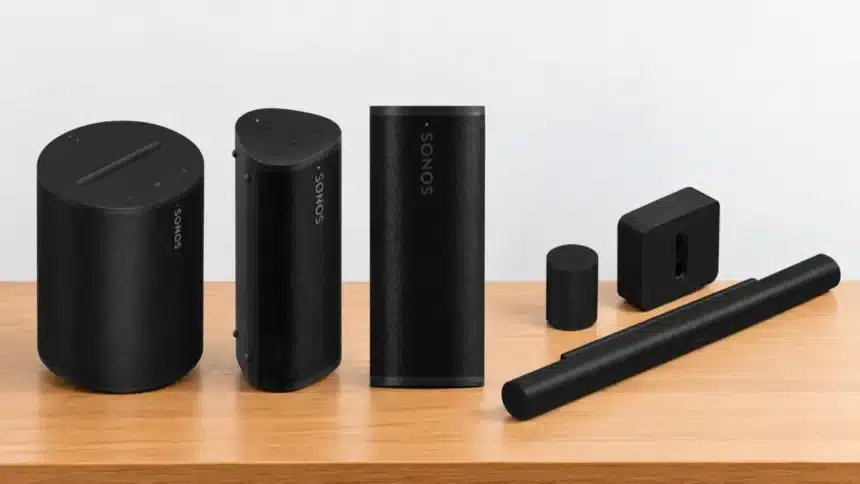
By fusing seamless wireless connectivity, high-fidelity sound, and modular design, Sonos has become a leading brand in home audio. A Sonos configuration, which is based on a flexible network, enables customers to begin with a single speaker and grow into a specialized multi-channel home theater or a whole-house audio architecture.
The main speaker categories are broken down in detail below, along with direct links to learn more about each product.
1. Portable Speakers: Versatile Sound On the Go
Sonos portable speakers can easily switch between home network streaming over Wi-Fi and listening away from home over Bluetooth.
- Sonos Roam 2: A durable, lightweight, and incredibly small portable speaker. It is a convenient grab-and-go choice for travel and outdoor activities because of its IP67 dust and water protection.
Verification: Roam 2 supports Bluetooth audio streaming and can be submerged in up to 1 metre of water for up to 30 minutes. Its battery provides up to 10 hours of continuous playback under specified conditions.
- Sonos Move 2: A powerful portable speaker made for large rooms and outdoor areas. It has an enhanced stereo architecture, a battery life of up to 24 hours, and automatic Trueplay™ tuning that adjusts sound according to its environment.
Verification: Automatic Trueplay continually optimises the speaker’s sound for its surroundings and audio content. It can retune as the speaker moves between locations.
2. Smart Home Speakers: Room-Filling Fidelity & Spatial Audio
These speakers are intended for stationary use at home and can be used as surround channels in home theater systems or as stand-alone music players.
- Sonos Era 100: The compact smart speaker delivers rich stereo sound and deep bass in small to medium rooms. It features two angled tweeters and a mid-woofer.
Verification: The Sonos app supports playback control and system management. Era 100 also supports Wi-Fi, Bluetooth, and line-in audio with the required adapter.
- Sonos Era 300: Designed to work with Dolby Atmos and spatial audio. Its acoustic design uses six strategically positioned drivers around the front, sides, and top to create an immersive three-dimensional audio experience.
Verification: When compatible Dolby Atmos Music is playing from a supported service over Wi-Fi, the Sonos app displays a Dolby Atmos badge on the Now Playing screen.
- Sonos Five: Audiophiles will appreciate this powerful high-fidelity speaker. It has an analog line-in input for connecting external sources, such as turntables, and three high-excursion mid-woofers.
Verification: Line-in audio can be selected in the Sonos app. Autoplay can also be configured to switch the system to line-in playback when a connected source begins playing.
3. Subwoofers: Deep, Low-Distortion Bass
By handling low-frequency output, a subwoofer can improve the overall dynamic range and clarity of a compatible Sonos system.
- Sonos Sub Mini: Dual force-cancelling woofers in a compact cylindrical design help reduce cabinet vibration and deliver clear, low-end output for small to medium-sized spaces.
Verification: Sonos describes the Sub Mini’s force-cancelling design as helping to reduce distortion and unwanted vibration. Listening to bass playback is a more useful way to assess performance than touching the cabinet.
- Sonos Sub 4: A powerful subwoofer designed for compatible home theater systems. It produces deep bass for music and movies.
Verification: The Sonos app allows users to adjust the bass and volume settings of a Sub 4 paired with compatible Sonos products.
4. Home Cinema & Soundbars: Cinematic Realism
With their wide sound stages and clear dialogue delivery, Sonos soundbars serve as the foundation for home entertainment systems.
- Sonos Beam (Gen 2): A compact soundbar that supports Dolby Atmos and is suitable for apartment environments and mid-sized TVs.
- Sonos Arc Ultra: For specialised movie setups, this high-end soundbar uses Sound Motion™ technology and a 14-driver acoustic architecture to deliver a 9.1.4 Dolby Atmos spatial audio experience.
Ecosystem Product Comparison
| Category | Model | Primary Use Case | Key Feature | Connectivity |
| Portable | Sonos Roam 2 | On-the-go / Outdoor | Compact, IP67 dustproof and waterproof | Wi-Fi & Bluetooth |
| Portable | Sonos Move 2 | Patio / Large Portable | 24-hour battery, Auto Trueplay | Wi-Fi & Bluetooth |
| Smart Speaker | Sonos Era 100 | Bookshelf / Small Rooms | Two tweeters, stereo sound | Wi-Fi, Bluetooth, Line-In |
| Spatial Audio | Sonos Era 300 | Immersive Music / Surrounds | Dolby Atmos spatial audio | Wi-Fi, Bluetooth, Line-In |
| High-Fidelity | Sonos Five | Music Listening / Turntables | Three mid-woofers, integrated line-in | Wi-Fi, 3.5 mm Line-In |
| Subwoofer | Sonos Sub Mini | Small/Medium Rooms | Dual force-cancelling woofers | Wi-Fi |
| Subwoofer | Sonos Sub 4 | Home Theater / Larger Rooms | High-output deep bass | Wi-Fi, Ethernet |
Core Technologies
- Trueplay™ tuning: Measures room acoustics and adjusts speaker sound to account for reflections from walls, surfaces, and furniture. Availability and tuning methods vary by product.
- Unified App Control: Manage supported streaming services, internet radio stations, TV audio, and multi-room grouping through the Sonos app.
- Multi-Room Audio: Install speakers in multiple rooms to broadcast synchronised music across the house or play different tunes in various zones.
Conclusion
The Sonos ecosystem offers a versatile platform for both casual music listeners and enthusiasts of high-end home theater. Its modular design allows users to begin with a single speaker, like the Era 100 or Roam 2, and gradually build a multi-room system or surround-sound home theater over time. Sonos combines software optimisation, including Trueplay™, with flexible hardware options to deliver a tailored listening experience throughout the home.