


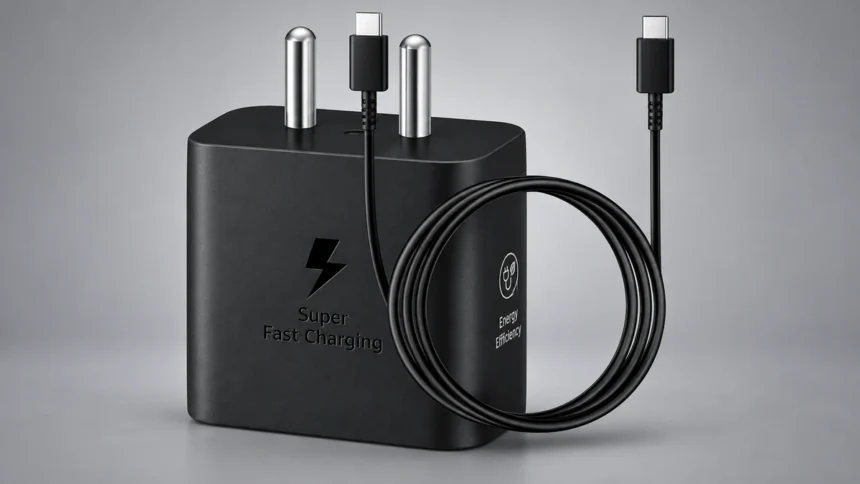
As you wait in line to pay at Best Buy, you notice a wall full of USB-C chargers. One says 20W, another says 65W, and the third says 140W, but they all look pretty much the same. It could charge very slowly or you could pay too much for power you won’t use if you choose the wrong one. The key to getting everything in order is that little “PD” label on the box.
Find out what a Power Delivery charger is, how the wattage numbers show how much power it can deliver, and how to choose the right one for your devices and home outlets.
What Is a Power Delivery (PD) Charger?
When you connect your charger to your device, USB Power Delivery (PD) lets compatible devices and chargers communicate to negotiate how much power should be delivered. A basic USB charger may provide power using fixed charging capabilities. A PD charger, on the other hand, can negotiate with your phone, tablet, or laptop to determine an appropriate power level supported by both the charger and the device.
A few things worth knowing:
- It’s not a brand thing: USB Power Delivery is an industry charging standard used across devices from major manufacturers. This means that one compatible charger can often charge more than one device.
- USB PD is primarily associated with USB-C: Modern USB Power Delivery uses USB-C connections. Older USB-A charging methods don’t provide the same modern USB-C PD capabilities.
- It makes charging more flexible: Instead of relying on a single charging level, USB PD allows compatible chargers and devices to negotiate supported voltage and current levels, making the same charger useful for devices ranging from phones to laptops.
How Does PD Actually Work?
This is how PD really works:
- Negotiation, not force-feeding: The charger and device exchange information and determine an appropriate voltage and current for the current situation, whether it is a low-power device such as earbuds or a laptop that can accept much more power.
- Different voltage profiles: USB PD supports multiple voltage levels. USB PD 3.1 expanded the standard with 28V, 36V, and 48V fixed-voltage options, allowing compatible USB-C systems to deliver up to 240W.
- Higher wattage doesn’t mean forced power: A 100W PD charger won’t automatically push 100W into your phone. A compatible device negotiates a supported power level with the charger, so a bigger number on the box doesn’t mean the charger forces all of that power into a smaller device.
Wattage Explained: What the Numbers Actually Mean
When you multiply volts by amps, you get watts. Watts represent the amount of electrical power a charger can deliver. More available wattage can enable faster charging, but only when the device, charger, charging protocol, and cable all support the required power level.
Rough wattage needs by device type:
- Phones: Around 20-45W for many current models, depending on the device and charging standard
- Tablets: Around 20-45W or higher, depending on the model
- Laptops: Around 45-140W for many USB-C laptops, although some high-performance laptops may require more power or a proprietary power adapter
But there is a catch: the charger is only one part of the equation. No matter how powerful the brick is, a cable that isn’t rated for the required wattage can limit the power available to your device.
Recommended PD Wattage by Device
| Device | Practical Charger Wattage |
| iPhone 15/16 series | 20W or higher; exact charging performance varies by model |
| Android Phone (Galaxy, Pixel) | 25-45W or higher, depending on model and required charging protocol |
| iPad / Android Tablet | 20-45W or higher, depending on model |
| MacBook Air | 35-70W, depending on model and desired charging speed |
| MacBook Pro (14″/16″) | 70-140W, depending on model and desired charging speed |
| Windows Ultrabook | Typically 45-100W, depending on model |
| Nintendo Switch | Use a compatible USB-C PD charger that meets the console’s requirements; Nintendo’s official Switch AC adapter is rated for up to 39W output |
Does It Matter That You’re in the US?
Yes, but mainly when it comes to the charger’s AC input rating, plug type, and safety certification rather than the USB-C PD wattage delivered to your device.
- US homes commonly use 120V power: Many modern USB-C chargers support a wide AC input range, often around 100-240V, and internally convert AC power to the DC voltage negotiated with your device. Always check the input-voltage rating printed on the charger before using it, especially when traveling internationally.
- GaN chargers are widely available: Gallium nitride (GaN) technology can help manufacturers build compact and efficient high-power chargers, which is why it is commonly found in many modern multi-port and high-wattage chargers.
- Look for recognized safety certification: When buying a charger in the US, look for a product that has been evaluated by a recognized safety certification organization. A UL Mark, for example, indicates that the product has been certified to applicable requirements by UL Solutions.
Common Mistakes People Make
This is a list of mistakes that people commonly make:
- Thinking that a higher wattage always means a faster charge. A charger with 140W won’t necessarily charge a phone faster than a lower-wattage charger once the phone reaches its supported charging limit.
- Pairing a high-wattage charger with the wrong cable. USB-C cables have different power capabilities. Under current USB-IF labeling requirements, certified USB-C to USB-C cables are identified for 60W or 240W power capability, so check the cable as well when charging higher-power devices.
- Not separating PD and Quick Charge. Qualcomm’s Quick Charge and USB Power Delivery are different fast-charging technologies. Compatibility depends on the charger, device, and supported charging protocols.
How to Pick the Right Wattage: Quick Checklist
To help you choose the right wattage, here is a list:
- Find the power input that your device can handle: Check the manufacturer’s specifications or support documentation to find its charging requirements. For example, Google specifies a 30W USB-C PPS charger or higher for fast charging the Pixel 10.
- Choose enough wattage for the device: Buying a charger with some additional capacity can be useful for future devices, but extra wattage above your device’s supported charging rate won’t automatically make it charge faster.
- If you frequently charge your phone, tablet, and laptop at the same time, you might want to look into a multi-port charger. Just make sure you check how the charger’s total power is distributed across its ports when multiple devices are connected.
- The charger and cable should go together: If you use a high-wattage brick with a cable that doesn’t support the required power, you won’t get the charging performance you paid for.
The Bottom Line
With a Power Delivery charger, compatible devices and chargers negotiate an appropriate amount of power. Finding the charger with the highest wattage isn’t the important part. What’s important is matching the charger and cable to your most power-hungry device and then leaving a little extra room for the next thing you plug in.
Frequently Asked Questions
Can a PD charger damage my phone?
A properly designed, standards-compliant USB PD charger should not push its maximum rated wattage into a compatible phone. The charger and device negotiate a supported power level. However, you should still use reputable chargers and cables that meet appropriate safety and USB specifications.
Do I need a special cable for PD charging?
The cable matters, especially at higher power levels. Current USB-IF requirements distinguish USB-C to USB-C cables by power capability, including 60W and 240W. To get the charger’s full supported output, use a cable rated for the power your device requires.
Can one charger power my laptop and phone at the same time?
A lot of the time, yes. Many multi-port PD chargers distribute their total available power across multiple ports. Check the charger’s power-allocation specifications because the maximum output of an individual port can change when multiple devices are connected.
Is a 100W+ charger overkill for just a phone?
Usually, yes, if you only want to use it for a phone that charges at a much lower wattage. But the extra capacity can be useful if you also have a USB-C laptop, tablet, or other higher-power device.