




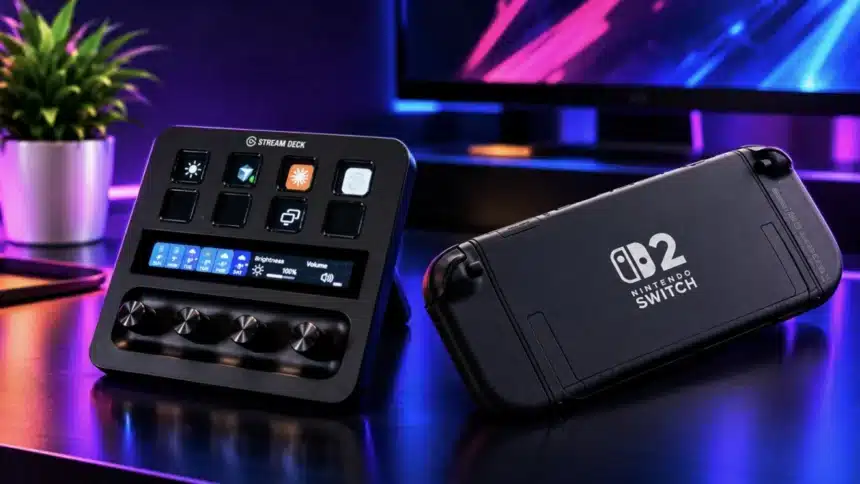
The market for handheld games has changed a lot, giving gamers more ways to play their favorite games without being tethered to a TV or computer. The Nintendo Switch 2 and the Steam Deck OLED are two devices that stand out in this field. Both are great portable gaming options, but they are made for different kinds of players. Nintendo focuses on making a polished console experience with exclusive games and different ways to play. Valve, on the other hand, is more focused on PCs and offers a huge library of games through Steam.
Comparing graphics, processing power, or screen quality is not enough to choose between these two handhelds in 2026. It’s also important to know what kind of gaming you want. Do you like games that are only available on Nintendo, games that are good for the whole family, and being able to easily switch between handheld and TV gaming? Or would you rather be able to choose from thousands of PC games, make your experience more unique, and have more control over it? Let’s look at the Nintendo Switch 2 and the Steam Deck OLED side by side to see which one is better in 2026.
Nintendo Switch 2: The Best Choice for Nintendo Fans and Casual Gamers
The Nintendo Switch 2 is a big improvement over the first Nintendo Switch. It has faster performance, a bigger screen, and better gaming experiences. It came out in June 2025 and continues Nintendo’s hybrid gaming philosophy by letting players play games on the go, at a table, or on TV.
One of the best new features is the 7.9-inch LCD screen that has a resolution of 1920 x 1080, HDR10 support, and a refresh rate of up to 120Hz. When you play games that support higher refresh rates, this makes them look sharper and smoother. The console has a custom NVIDIA processor, 256GB of built-in storage, and the ability to use microSD Express cards that are compatible.
Another good reason to think about the Switch 2 is its performance. Compared to the previous console, this one has better graphics, loads faster, and can play games that are harder. When connected to a TV that works with its dock, it can also handle up to 4K resolution at 60Hz. But the performance you get depends on the game, and not all of them run at 4K.
The Switch 2’s best feature is still its Nintendo-only games. Popular series like Mario, The Legend of Zelda, Pokémon, and Donkey Kong let players do things that they can’t do on other handheld systems. Nintendo is also making experiences that work best with its newest hardware, as shown by games like Mario Kart World and Donkey Kong Bananza.
The redesigned Joy-Con 2 controllers are another cool thing about the game. They stick on magnetically and give you better control. The fact that they can also be used as a mouse gives you more ways to play. For multiplayer games, players can also take off their controllers, which makes the console great for families and groups of friends.
In spite of this, the Nintendo Switch 2 is not perfect. Its LCD screen can’t show deep blacks and high contrast like an OLED panel can. Another concern is the battery life. Nintendo says it will last between 2 and 6.5 hours, depending on the game and how it is used. It may also feel small with only 256GB of storage if you often download big games.
Who should buy the Nintendo Switch 2?
- Nintendo fans: This is the best console for you if you like Mario, Zelda, Pokémon, and other Nintendo-only games.
- Casual gamers: It’s good for players who don’t want the complexity of PC gaming because it has a simple interface and controls that are easy to understand.
- Families and multiplayer enthusiasts: Detachable Joy-Con 2 controllers make local multiplayer gaming convenient.
- Frequent travellers: Its lighter design and flexible handheld and tabletop modes make it a practical travel companion.
- Original Switch owners: If you want better hardware, improved visuals and access to newer Nintendo games, upgrading makes sense.
Steam Deck OLED: The Better Choice for PC Gamers and Performance Enthusiasts
When it comes to portable gaming, the Steam Deck OLED is very different. It is basically a small gaming PC that was made by Valve so that players can access their Steam library without a desktop or laptop.
Nintendo’s approach is focused on consoles, but the Steam Deck OLED uses SteamOS, a Linux-based operating system that gives you a gaming interface like a console while still letting you do many PC things. This gives players more options for downloading games, changing settings, and taking charge of their gaming experience.
The best thing about it is the 7.4-inch HDR OLED screen. At 1280 x 800 pixels, the OLED panel has a lower resolution than the Switch 2, but it has great contrast, bright colors, and deep blacks. It also has a refresh rate of up to 90Hz, which makes games that work with it look smooth and nice to look at.
The AMD APU in the Steam Deck OLED is custom made and has a Zen 2 CPU and RDNA 2 graphics. Your choice of 512GB or 1TB of storage space and 16GB of LPDDR5 RAM make it great. The hardware in it is older than that in the Switch 2, but it can still run many PC games.
The best thing about it is that it lets you use the Steam ecosystem. There are thousands of PC games to choose from, such as new and popular games, independent games, and old favorites. Having a large Steam library is very helpful because you don’t have to buy your favorite games all over again if you already have them.
You could also get discounts on Steam, which can help you save money over time as you build up your game library. But compatibility isn’t always the same. Valve sorts games into four groups: Verified, Playable, Unsupported, and Unknown. This helps users figure out how well each game works.
Another benefit is that it can be customized. To get the best performance and battery life, players can change the graphics settings, frame rates, resolution, and how much power they use. It also has two trackpads, gyro controls, full-sized thumbsticks, and four rear buttons that can be programmed.
The Steam Deck OLED can do more than just play games. It can also be used as a small computer. Its desktop mode lets users browse the web, install apps that work with it, connect peripherals, and do other basic work-related tasks. It can also connect to an external monitor with the right dock or USB-C hub.
Battery life is another strength on paper. Valve says that you can play for about 3 to 12 hours, depending on the game and the settings you choose. However, AAA games that are very demanding can drain the battery a lot faster.
There are some problems that you should think about. At about 640 grams, the Steam Deck OLED is pretty heavy, which can make it less comfortable for some users to hold for long periods of time. Plus, you need to know more about technology to use it than a regular game console. Not all Steam games work perfectly, and some multiplayer games with anti-cheat systems that don’t work with Steam may not be able to be played at all.
Who should buy the Steam Deck OLED?
This is what the Steam Deck OLED is great for:
- PC gamers: You can take many of your favorite games with you if you already have a large Steam library.
- Fans of AAA games: PC gamers who like games like Cyberpunk 2077, Elden Ring, and The Witcher 3 will enjoy this feature.
- Individual game fans: Steam has a huge selection of independent games, often at great discounts.
- Tech enthusiasts: If you enjoy customising settings, installing applications and experimenting with different configurations, the Deck offers plenty of flexibility.
- Budget-conscious game collectors: Frequent Steam discounts can help reduce the long-term cost of building a large digital library.
Nintendo Switch 2 vs Steam Deck OLED: Which One Wins?
Before making a final decision, it is worth looking at how both devices compare across the most important categories.
| Feature | Nintendo Switch 2 | Steam Deck OLED |
| Display | 7.9 Inch LCD | 7.4 Inch OLED |
| Resolution | 1920 x 1080 | 1280 x 800 |
| Refresh Rate | Up to 120Hz | Up to 90Hz |
| Processor | Custom NVIDIA | Custom AMD |
| RAM | Not officially specified in Nintendo’s standard tech specs | 16GB LPDDR5 |
| Storage | 256GB | 512GB / 1TB |
| Battery estimate | 2–6.5 hours | 3–12 hours |
| Operating system | Nintendo system software | SteamOS |
| Game library | Nintendo and compatible Switch games | Steam and compatible PC games |
| TV connectivity | Included dock | Compatible dock sold separately |
| Weight | Approximately 534g with Joy-Con 2 | Approximately 640g |
The gaming ecosystem is the main difference. Nintendo has exclusive games and a simpler console experience, while Valve gives you access to a huge library of PC games.
Another interesting comparison is the quality of the display. The Switch 2 has a better resolution and refresh rate, but the Steam Deck OLED has better black levels and contrast. There is no clear winner between the two screens; it depends on your priorities: OLED picture quality or sharpness and refresh rate.
Paying attention to prices is also important. Because the dock is already included, buying the Switch 2 is usually easier. The Steam Deck OLED can cost a lot more, depending on where you buy it and how much stock there is.
Conclusion
The Nintendo Switch 2 and the Steam Deck OLED are both great handheld game consoles, but they are made for different types of gamers. With the Switch 2, gaming is easier to get into, there are great Nintendo-only games, and you can switch between handheld and TV gaming. The Steam Deck OLED, on the other hand, gives you more control over your software, a great OLED screen, and access to a huge library of PC games.
If you like to play around with settings, try out new PC games, and take advantage of Steam deals, the Steam Deck OLED is a great purchase. The Switch 2, on the other hand, is better if you want an easy experience, like Nintendo games, and want a console that the whole family can use.