



Do you want to buy a new phone, watch, or TV? Then you’ve probably seen the terms “OLED,” “AMOLED,” and “LTPO” thrown around on spec sheets as if they were three competing technologies. You might be wondering why they’re competing with each other.
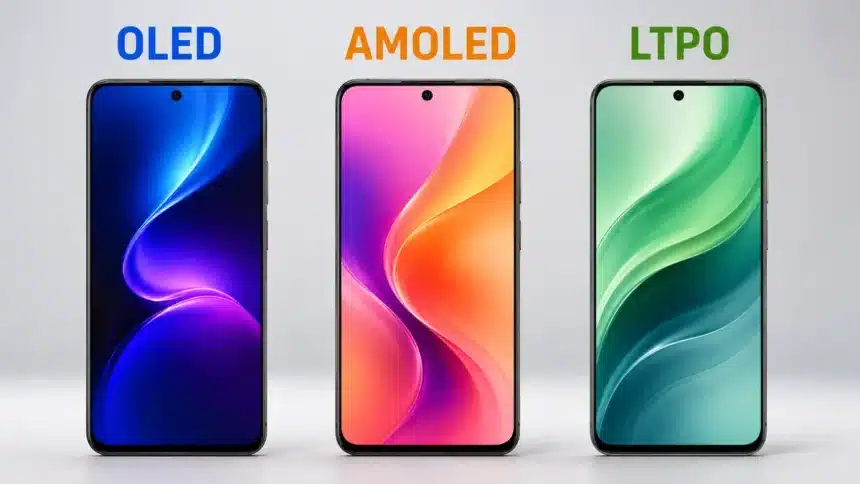
Understanding OLED vs AMOLED vs LTPO starts with knowing how these three terms are connected. OLED is the technology behind the display. AMOLED is a certain way that an OLED screen can be made. And LTPO is a backplane technology used with an AMOLED screen. Instead of sitting next to each other, they describe different parts of the same display system.
To put it simply, OLED is like a coffee bean. AMOLED is the espresso machine that brews it in a specific way. LTPO is the smart pressure control added to that machine, which automatically adjusts based on what’s being made. It’s not like saying “espresso vs. the machine” because both use the same technology.
Let us take a look at what’s going on behind the glass.
What is OLED?
The name “OLED” tells you everything you need to know about the technology. An LCD screen uses a backlight to shine through a layer of liquid crystal to make an image. An OLED panel, on the other hand, is made up of tiny organic compounds that light up when electricity flows through them. There’s no need for a backlight because each pixel is its own tiny light source.
Most of OLED’s unique strengths come from the idea of a “self-lighting pixel”:
- It’s really black when a pixel that should be black turns off completely.
- Very strong contrast. Black is “off,” not “dim,” so dark scenes don’t look washed out.
- Panels are thinner and lighter, with no backlight layer taking up space.
- Pixels that respond quickly help make motion smooth and reduce motion blur at higher refresh rates.
What’s interesting is that “OLED” describes the self-emissive display technology; it doesn’t specify the type of transistor backplane used to control those millions of pixels. The next level is in charge of that job.
What is AMOLED?
Active Matrix Organic Light Emitting Diode is what AMOLED stands for. The “Active Matrix“ part is a grid of thin-film transistors that sit behind the pixels. These transistors control the current supplied to individual pixels, allowing their brightness to be adjusted independently.
This is not the same as older passive matrix OLED (PMOLED) displays, which manage pixels in groups of rows and columns instead of one at a time. PMOLED is fine for small, simple screens like those on calculators, but its passive-matrix addressing does not scale as efficiently for high-resolution screens like those on smartphones.
The part that confuses people is that most OLED screens in modern phones and smartwatches already use active-matrix designs. This means that even though the brand name only says “OLED,” the screen can still use an active-matrix OLED design.
Samsung’s “Super AMOLED” brand made the AMOLED name well-known. This brand also builds the touch sensor right into the display layer instead of putting a separate sheet on top. LG’s OLED panels are used in both phones and TVs. Many use active-matrix driving, although LG generally markets them simply as “OLED” rather than “AMOLED.”
This means that AMOLED and OLED are closely related screen technologies in the real world. AMOLED specifically refers to an active-matrix implementation of OLED. The different names are also influenced by how the different manufacturers choose to brand their products. The displays underneath are not actually entirely different technologies.
What is LTPO?
From a tech point of view, this is where things really get interesting. You should know that LTPO, which stands for Low-Temperature Polycrystalline Oxide, is not a new type of screen.
It’s a backplane technology, which means it talks about the transistors that are under the pixels. It’s a backplane technology commonly used with AMOLED panels, rather than a separate type of display.
Here’s the core idea:
- LTPS (Low-Temperature Polysilicon) transistors have been used in standard AMOLED panels for a long time. Because it can quickly push a lot of current, LTPS has been the best choice for years for making OLED screens that are sharp and have a high refresh rate. On the other hand, LTPS transistors leak some current, which makes them less efficient at very low refresh rates when the content is static.
- On the same backplane, LTPO panels have both LTPS transistors and oxide transistors, which can use materials such as IGZO (indium gallium zinc oxide). Oxide transistors leak a lot less current, which means they can keep a pixel’s state stable for a lot longer before it needs to be refreshed.
The benefit is an adjustable refresh rate, including the ability to operate efficiently at very low refresh rates. If you look at what’s on the screen, an LTPO panel can smoothly change its refresh rate up and down, depending on the panel and device, with some ranging from 1Hz to 120Hz (or higher).
Do you spend your time on social media or a fast-paced game? Moving on a panel that goes up to 120Hz makes the motion very smooth. Reading a static article or taking a quick look at a clock face that’s always on? It can go as low as one or two Hz because there’s no need to draw the same picture over and over again dozens of times a second.
That adaptable behavior is what makes a few things possible that people today take for granted:
- Displays that are always on and use less power while showing static information
- High-end phones with adaptive refresh rate systems (Apple calls its version “ProMotion”)
- Smartwatches that can work and stay lit all day while reducing display power consumption
Most of the time, an LTPO panel can use less power than a fixed-refresh AMOLED panel when the screen is not moving. This is most noticeable when the screen is reading, when it is not being used, or when the clock face is always on.
OLED vs AMOLED vs LTPO: Side-by-Side Breakdown
Here is a side-by-side breakdown of OLED, AMOLED, and LTPO:
| OLED | AMOLED | LTPO (AMOLED) | |
| What is it? | Self-emitting organic pixel technology | Active-matrix control layer for OLED pixels | Advanced backplane (LTPS + oxide transistors) added to AMOLED |
| Relationship to the others? | The base technology | A specific, near-universal implementation of OLED | An advanced backplane used with AMOLED |
| Refresh rate behavior? | Depends on implementation | Fixed or variable, depending on implementation | Variable/adaptive (e.g., 1-120Hz, depending on the panel) |
| Power efficiency? | Depends on implementation | Depends on implementation | Can offer better efficiency, especially with static content |
| Where does it commonly show up? | Phones, TVs, watches, tablets, and laptops | Many modern OLED phone, TV, and watch displays | Flagship phones, premium watches, high-end foldables |
| Manufacturing complexity? | Baseline | Baseline | Higher. More complex to produce. |
Read Also: LCD vs OLED vs AMOLED: Smartphone Display Technologies Compared
Putting It All Together
OLED talks about the pixels, which are made of organic material that lights up by itself. It’s called AMOLED because it controls those pixels with an active-matrix transistor grid, which is pretty much what every modern OLED screen has. LTPO refers to an improved backplane that is used with AMOLED screens and allows for variable refresh rates and better power efficiency.
Actually, these three terms describe different parts of the same display system, not three separate technologies competing for the same spot on a spec sheet. Together, they describe different aspects of how a modern OLED display produces, controls, and refreshes its image.
Visit Devicology for the latest Tech News, Guides, and in-depth Reviews. Follow us on Whatsapp, LinkedIn, X (Twitter) and Instagram to never miss an update!