
Hisense accounted for around 13% of global TV shipments in Q1 2026. Here is a no-nonsense guide to the Hisense TV series covered in this article, who each series is for, and which one deserves your money.
There is a good chance you have already seen a Hisense TV without realizing it. Maybe it was the surprisingly sharp display at your Airbnb. Maybe it was the 100-inch screen at Best Buy that made you stop mid-aisle and think, “Wait, that is only how much?”
That reaction is basically Hisense’s entire business strategy.
Founded in 1969 as a small radio factory in Qingdao, China, Hisense has quietly grown into the third-largest TV manufacturer by global shipments. In Q1 2026, the company accounted for around 13% of global television shipments, trailing only Samsung and TCL. They are also one of the world’s largest shippers of 100-inch TVs. And with the FIFA World Cup 2026 hosted across the United States, Canada, and Mexico, Hisense pushed harder than ever to win over American living rooms.
But walk into Best Buy or browse hisense-usa.com and you will find a dizzying alphabet soup: QD6, QD7, U6, U7, U8, UR8, UR9, UX. Some run Fire TV. Some run Google TV. Prices range from “cheaper than my grocery bill” to “more than my car.”
Let’s make sense of all of it.
- How the Lineup Is Structured
- QD6 Series: The Budget King
- QD7 Series: Budget Meets Mini LED
- U6 Series: The Everyday Mini LED Workhorse
- U7 Series: The Sports and Gaming Powerhouse
- U8 Series: Mini LED Turned Up to Eleven
- UR8 Series: RGB Mini LED Without Going Full Flagship
- UR9 Series: RGB Mini LED Enters the Chat
- UX Series: The $30,000 Statement Piece
- Hisense TV Series at a Glance
- Quick Tech Decoder
- Which One Should You Actually Buy?
- The Bottom Line
How the Lineup Is Structured
Hisense splits the TV series covered here into three tiers:
- QLED Series (QD6, QD7): Entry-level and mid-range. Quantum dot color at prices that undercut everyone. Fire TV platform.
- ULED Mini LED Series (U6, U7, U8): The performance-to-value sweet spot. Mini LED backlighting on top of QLED color for better contrast and brightness. Fire TV or Google TV.
- RGB Mini LED Series (UR8, UR9, UX): Ultra-premium. The backlight uses red, green, and blue LEDs, delivering a wider color gamut than traditional Mini LED. Hisense’s answer to OLED.
Now let’s break down each series.
QD6 Series: The Budget King
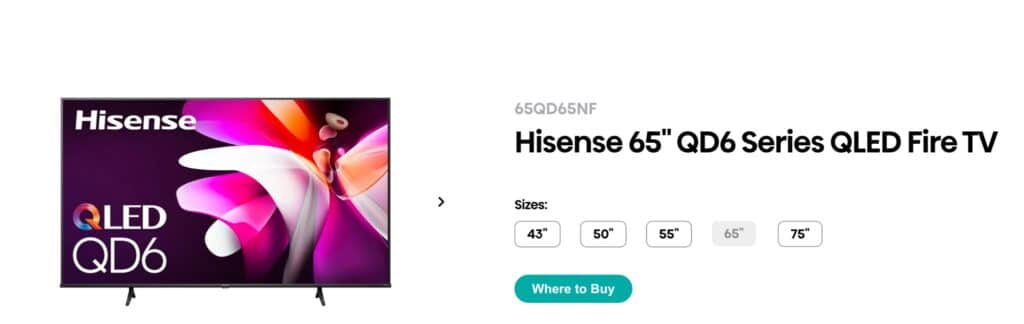
Tech: QLED | Platform: Fire TV | Sizes: 43″ to 100″ | Starting Price: ~$230
The QD6 is Hisense’s entry point, and “entry-level” does not mean bad. It uses quantum dot color to display over a billion shades. You also get a native 144Hz panel with VRR for gaming, full HDR support (Dolby Vision IQ, HDR10+), Dolby Atmos, and Alexa built in.
The 85-inch QD6 has been spotted at $899. At that price, you are getting quantum dot color and a 144Hz panel for less than Samsung charges for a basic Crystal UHD.
Best for: First apartments, guest rooms, budget-conscious families, and anyone who wants a genuinely good TV without overthinking it.
QD7 Series: Budget Meets Mini LED
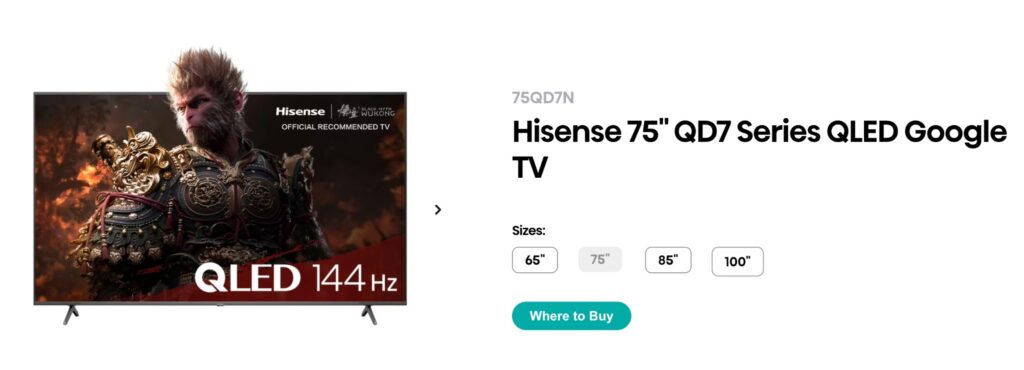
Tech: Mini LED QLED | Platform: Fire TV | Sizes: 50″ to 100″ | Starting Price: ~$437
The QD7 takes everything the QD6 does and adds Mini LED backlighting. That means thousands of tiny LEDs instead of a few dozen, allowing the TV to control brightness in much smaller zones. The result: brighter highlights, deeper blacks, and less blooming.
Tom’s Guide reviewed the QD7 and said it “makes all the right tradeoffs for a pleasing picture at a low price.” The 65-inch lists at $499 and has dropped to $437 at Amazon and Best Buy.
Best for: Gamers on a budget, movie lovers who want better contrast, and anyone upgrading from a 5-year-old TV who wants to feel the difference without spending $1,000.
U6 Series: The Everyday Mini LED Workhorse
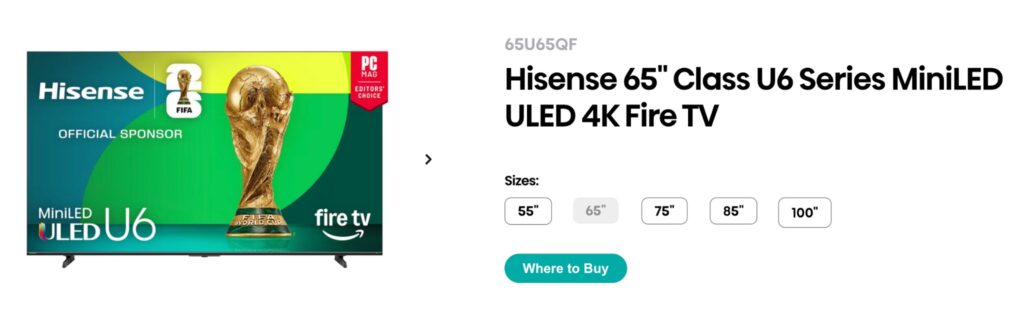
Tech: ULED Mini LED | Platform: Fire TV / Google TV | Sizes: 50″ to 100″ | Starting Price: ~$350
The U6 is where Hisense’s proprietary ULED processing kicks in. It layers AI-driven scene-by-scene optimization on top of Mini LED and QLED, automatically adjusting brightness, contrast, and color without you touching a single setting.
It supports every major HDR format: Dolby Vision IQ, HDR10+ Adaptive, HDR10, and HLG. That matters because Netflix supports Dolby Vision, Amazon Prime supports HDR10+, and the U6 plays nice with all of them.
The 2026 U6SF Pro variant has been turning heads. Tom’s Guide called the 100-inch model “the TV I recommend for budget shoppers looking for a larger-than-life screen.” The U6SF Pro is rated for up to 1,200 nits of peak brightness and has a glare-free finish.
Best for: Families who want one TV that handles everything: sports, movies, gaming, streaming. The 100-inch models are particularly compelling for home theater setups.
U7 Series: The Sports and Gaming Powerhouse
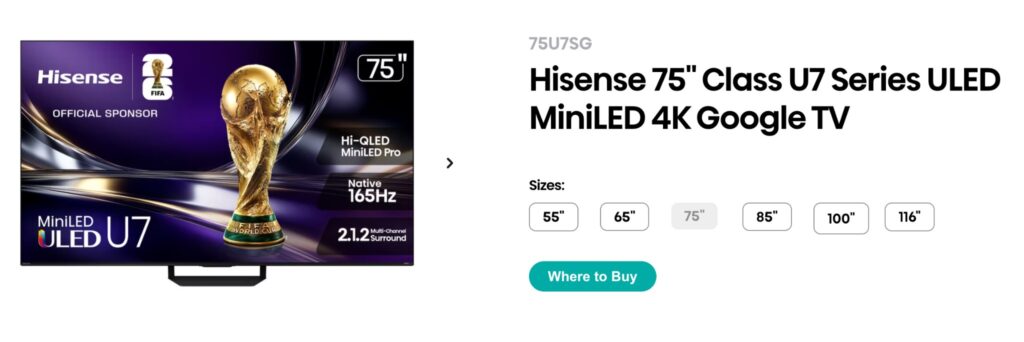
Tech: ULED Mini LED | Platform: Fire TV / Google TV | Sizes: 55″ to 116″ | Starting Price: ~$700
The U7 is Hisense’s performance tier, and it is specifically tuned for sports fans and gamers. The 2026 U7SG has been called the best Hisense TV overall for most buyers, pairing roughly 3,000 nits of peak brightness with a 165Hz panel.
That brightness number is significant. At 3,000 nits, the U7 punches through ambient light in even the brightest living rooms. Sunday afternoon football with the curtains open? No problem. For gamers, 165Hz Game Mode Ultra with VRR, ALLM, and HDMI 2.1 delivers smooth, tear-free gameplay.
The timing was no accident. With the FIFA World Cup 2026 played across the US, Canada, and Mexico, Hisense designed this TV to be the ultimate sports-watching machine. As James Fishler, Chief Commercial Officer at Hisense USA, put it: “People are gravitating toward larger screens and they are using them to bring people together.”
Best for: Sports fanatics, serious gamers, and anyone with a bright living room who needs a TV that fights glare.
U8 Series: Mini LED Turned Up to Eleven
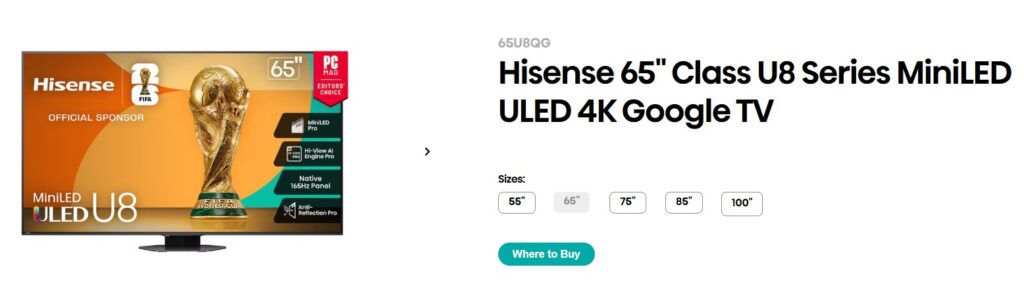
Tech: ULED Mini LED | Platform: Google TV | Sizes: 55″ to 100″
If the U7 is the sweet spot, the U8 is what happens when Hisense decides subtlety is overrated. MiniLED Pro pushes peak brightness up to 5,000 nits, while QLED Color, an Anti-Glare Low Reflection Pro panel, and a native 165Hz refresh rate make this one of the most aggressive traditional Mini LED TVs in the lineup.
That combination makes the U8 particularly interesting for bright rooms. Reflections are exactly where a lot of otherwise excellent TVs start to struggle, and Hisense is throwing both raw brightness and an anti-glare panel at the problem. For gamers, the 165Hz native refresh rate, VRR, ALLM, and FreeSync Premium Pro are built for high-refresh gameplay.
Hisense did not forget the speakers either. The U8 packs up to an 82W 4.1.2-channel audio system with Dolby Atmos. You may still want a dedicated sound system for a serious home theater, but this is not the kind of TV where the built-in speakers feel like an afterthought.
Best for: Bright living rooms, serious gamers, sports fans, and anyone who wants flagship-level Mini LED performance without stepping into RGB Mini LED territory.
UR8 Series: RGB Mini LED Without Going Full Flagship
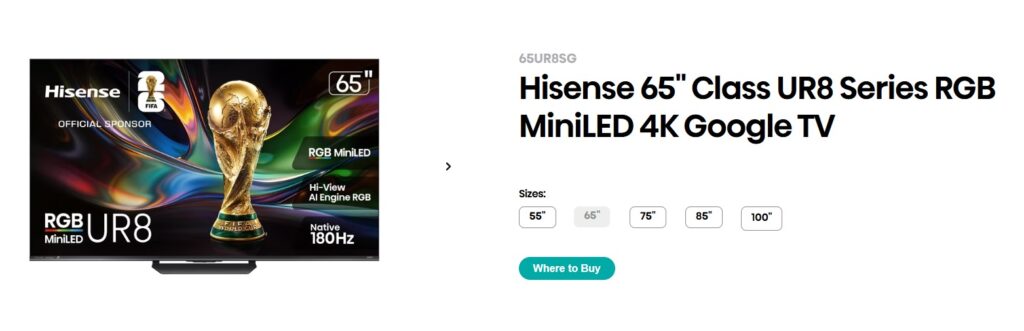
Tech: RGB Mini LED | Platform: Google TV | Sizes: 55″ to 100″
The UR8 is where Hisense starts making RGB Mini LED feel less like an exotic technology demo and more like something you might actually put in your living room. It uses red, green, and blue LEDs in the backlight instead of a conventional blue or white-light Mini LED system, with Hisense claiming up to 100% coverage of the BT.2020 color space.
And this is not just a color story. The UR8 reaches up to 3,800 nits of peak brightness and uses a native 180Hz panel, putting it firmly in serious gaming territory. It also supports Pantone certification and four HDMI 2.1 ports.
There is also Devialet audio. In other words, the UR8 is not the stripped-down version of Hisense’s RGB idea. It is the version designed to bring most of that technology down from the company’s most expensive TVs.
Best for: Movie lovers, gamers, and early adopters who want RGB Mini LED without jumping all the way to the UR9 or 116UXS.
UR9 Series: RGB Mini LED Enters the Chat
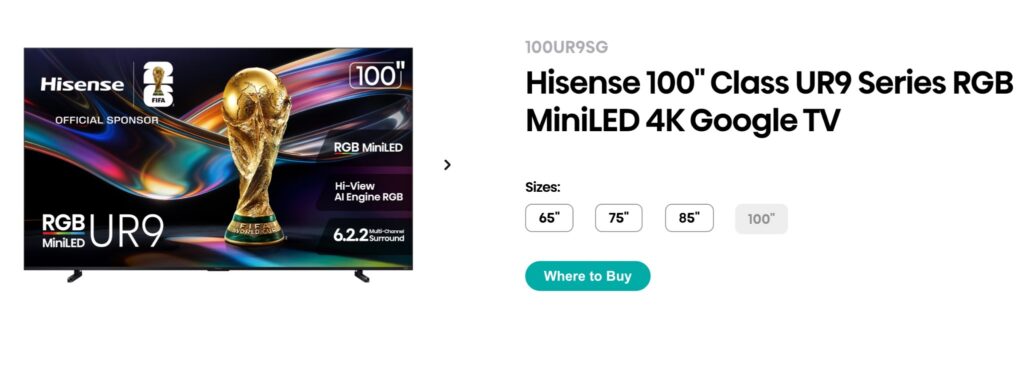
Tech: RGB Mini LED | Platform: Google TV | Sizes: 65″ to 100″ | Starting Price: ~$2,000
This is where things get genuinely different. In traditional Mini LED TVs, the backlight typically uses blue or white-light LEDs and filters color through quantum dots. In the UR9, the RGB Mini LED backlight uses red, green, and blue LEDs. The result is a wider color gamut that can display colors traditional Mini LEDs physically cannot reproduce.
The Verge confirmed the UR9 shows “colors beyond the P3 color space” and called it “a great first shot against OLED’s bow.” The 65-inch launched at $3,500 but quickly dropped to around $2,000 at retail, putting it in OLED territory.
Reviews are positive but measured. Ecoustics praised the “cutting-edge tech minus the inflated price.” PCMag noted “class-leading brightness and an enormous measured color range” but pointed out it does not yet surpass OLED in every scenario.
Best for: Home theater enthusiasts who want the widest possible color without going OLED, and anyone who watches a lot of HDR content in a bright room.
UX Series: The $30,000 Statement Piece
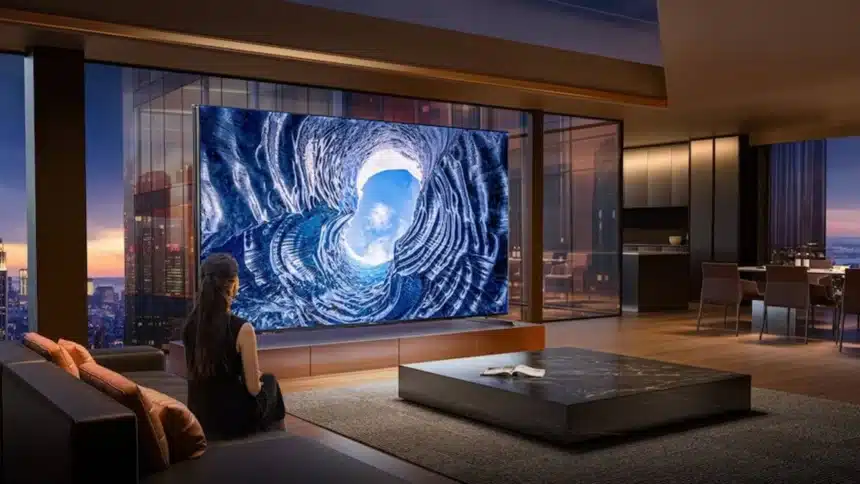
Tech: RGB Mini LED / RGB MiniLED evo | Platform: Google TV | Size: 116″ | Original 116UX Launch Price: $29,999
The 116UX is not for most people. But it represents the absolute ceiling of what Hisense can do. PCMag called it “the brightest and most colorful TV you can buy.” The original 116UX achieves 95% coverage of the BT.2020 color space, while the updated 116UXS model unveiled at CES 2026 uses a four-primary RGB MiniLED evo backlight that adds cyan and delivers up to 110% BT.2020 color coverage.
Best for: Dedicated home theater rooms, commercial installations, and anyone who looked at a 100-inch TV and thought, “I need bigger.”
Hisense TV Series at a Glance
| Series | Technology | Platform | Sizes | Starting Price | Peak Brightness | Standout Feature |
| QD6 | QLED | Fire TV | 43″ to 100″ | ~$230 | Standard | Quantum dot color at rock-bottom prices |
| QD7 | Mini LED QLED | Fire TV | 50″ to 100″ | ~$437 | Enhanced | Mini LED contrast on a budget |
| U6 / U6SF Pro | ULED Mini LED | Fire TV / Google TV | 50″ to 100″ | ~$350 | Up to 1,200 nits | Scene-by-scene AI processing |
| U7 / U7SG | ULED Mini LED | Fire TV / Google TV | 55″ to 116″ | ~$700 | ~3,000 nits | 165Hz gaming + sports brightness |
| U8 | ULED Mini LED | Google TV | 55″ to 100″ | Varies by size | Up to 5,000 nits | 165Hz flagship Mini LED performance |
| UR8 | RGB Mini LED | Google TV | 55″ to 100″ | Varies by size | Up to 3,800 nits | Up to 100% BT.2020 color coverage |
| UR9 | RGB Mini LED | Google TV | 65″ to 100″ | ~$2,000 | Up to 5,500 nits | Colors beyond P3 color space |
| UX / 116UXS | RGB Mini LED / RGB MiniLED evo | Google TV | 116″ | $29,999 original 116UX launch price | Up to 8,000 nits (116UX) | Up to 110% BT.2020 color coverage on 116UXS |
Quick Tech Decoder
| Technology | What It Does | Why It Matters |
| QLED | Quantum dots enhance color from the backlight | Over a billion color shades for vibrant, realistic pictures |
| Mini LED | Thousands of tiny backlight LEDs replace a few large ones | Precise brightness zones create deeper blacks and brighter highlights |
| ULED | Hisense’s picture technology combines display hardware and image processing | Optimizes picture quality across color, contrast, brightness, and motion |
| RGB Mini LED | Red, green, and blue LEDs produce light in the backlight | Wider color gamut than traditional Mini LED |
Which One Should You Actually Buy?
Just need a solid TV, no overthinking: The QD6 in whatever size fits your wall.
Want noticeably better picture without breaking the bank: The QD7 at 65 inches for ~$437 is one of the best deals in TVs right now.
Best all-around family TV: The U6SF Pro in 75 or 85 inches. Mini LED, full HDR, intelligent processing. The Goldilocks pick.
Gamer or sports fanatic: The U7SG. 3,000 nits, 165Hz, HDMI 2.1. Built for the World Cup and everything after it.
Want even more Mini LED performance: The U8. Up to 5,000 nits, 165Hz, and an anti-glare panel for bright-room viewing.
Want RGB Mini LED without going full flagship: The UR8. Up to 3,800 nits, native 180Hz, and up to 100% BT.2020 color coverage.
Home theater enthusiast: The UR9 at ~$2,000 for 65 inches. A compelling OLED alternative, especially in bright rooms.
The Bottom Line
Five years ago, recommending a Hisense felt like a gamble. The brand was known for being cheap, and “cheap” carried all the baggage that word implies.
That story is over.
In 2026, Hisense is not just competing with Samsung, LG, and Sony. In several categories, they are winning. The U7SG is arguably the best mid-range TV in America. The QD7 offers Mini LED at a price that makes competitors look greedy. And the UR9’s RGB technology is pushing the entire industry forward.
Whether you are furnishing your first apartment or building a dream home theater, Hisense has a TV that fits. And for the first time, that is not a compromise. It is a genuine recommendation.