

When you AirDrop a picture from your iPhone to a friend, have you ever noticed their device appear at the top of the sharing suggestions? Or used your phone like a key to open your car without pressing a button? Ultra-Wideband, or UWB, is a small piece of technology that’s easy to miss, which may have made that possible.
There’s been this option in high-end phones since 2019, but most people have never heard of it, even though they may have used it without realizing it. Let us talk about what it is and how it works.
What Is UWB?
The FiRa Consortium, which was founded in 2019 by companies including ASSA ABLOY, Bosch, HID Global, NXP Semiconductors, and Samsung, develops specifications and certification programs for interoperable UWB products. Ultra-Wideband is a wireless technology that transmits signals across a very wide portion of the radio spectrum, giving it much more bandwidth than conventional narrow-band wireless signals. That wider band is called an “ultra-wide” band, and it really does have a wider bandwidth than the narrow slices of spectrum that most wireless tech uses.
To put it simply, it’s a short-range radio technology that works a lot like Bluetooth or Wi-Fi. However, it was designed to answer one question very specifically: where is that other device, and how far away is it?
The Core Trick: Time-of-Flight
This is what makes the technology different from GPS or traditional Bluetooth proximity systems.
Compatible devices send and receive very short radio waves. By measuring how long it takes for waves to travel back and forth, a device can accurately determine how far away another device is. This kind of ranging is known as “time-of-flight.” Under suitable conditions, it’s possible to measure distance with centimeter-level accuracy because the signals are very short and spread out over such a large part of the spectrum.
Apple uses ultra-wideband technology for spatial awareness, so compatible iPhones can accurately determine the distance and direction of other supported devices. That’s the same kind of precise ranging process going on inside.
Traditional Bluetooth proximity systems often figure out how far away something is by measuring signal strength, or how strong a signal is when it gets to the receiver. Walls, interference, or even the way you hold your phone are much more likely to affect that method. However, newer Bluetooth Channel Sounding technology can also provide precise ranging using phase-based ranging and round-trip timing.
Why UWB Is So Much More Precise
The accuracy of this technology is very high for something running on a phone because of a few technical factors:
- Wide bandwidth, short pulses. The ranging process operates across wide portions of the multi-gigahertz spectrum, with the exact channels and frequency ranges depending on the device and regulatory region.
- Resistance to signal bouncing. One of the best things about the technology is how it handles the “multipath effect.” This is when a signal hits walls, furniture, or other things on its way to the receiver, making the reading less clear. Its wide bandwidth makes it better at distinguishing closely spaced signal paths, which can improve ranging accuracy in real-life, crowded places. Walls, people, and other obstacles can still affect its accuracy.
- Quick and regular updates. It can provide frequent position updates, which is fast enough to keep track of changes in the position of a moving object in real time.
All of these things work together to pinpoint a device’s location with centimeter-level accuracy under suitable conditions, which is highly accurate for close-range positioning.
Distance and Direction
The technology can tell your phone not only how far away something is, but also, on supported hardware, which direction it is in.
Supported hardware can combine precise ranging with direction-finding techniques to estimate both distance and relative direction. Some implementations can also combine this data with other sensors or camera-based positioning.
Because of this, an iPhone can show a precise arrow pointing towards another compatible device or AirTag instead of just a vague “you’re getting warmer” signal.
Apple says its Ultra-Wideband technology gives compatible iPhones spatial awareness, allowing them to understand their position relative to other nearby supported devices. The company has described this as “like adding another sense to iPhone.”
Where You’ll Actually Find UWB Working
Apple: According to Apple’s developer documentation, its Nearby Interaction framework makes it simple to add the technology to apps and hardware accessories. This lets users interact with a compatible product just by being close to it, and it also makes app experiences more precise and aware of their surroundings. When that happens in real life, it shows up in a few things:
- With AirTags and other compatible Find My items, it can enable precise distance and directional guidance through Precision Finding.
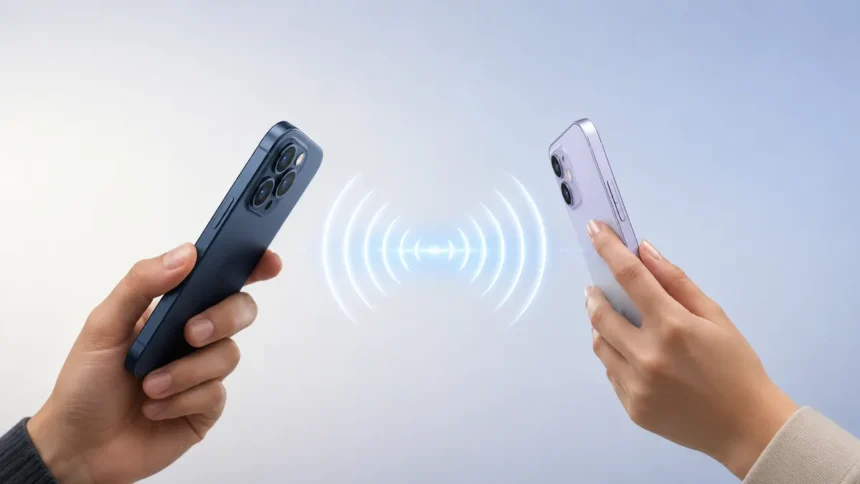
- When you point a compatible iPhone at another nearby iPhone, AirDrop can prioritize that person in the sharing interface.
- Some cars can read digital car keys and can tell when your phone is nearby or even inside the car without you having to touch anything.
- On supported devices, proximity-aware features can make transferring music between an iPhone and a HomePod mini easier.
Samsung and Android devices: Samsung was one of the first companies to join the FiRa Consortium, and it has since built the technology into its ecosystem to locate devices. Samsung’s SmartThings Find can use technologies including Bluetooth Low Energy and Ultra-Wideband for device-finding features on compatible hardware.
The UWB layer adds precise ranging and directional guidance on top of Bluetooth-based tracking on devices that support it.
Beyond phones. Beyond its accuracy, the FiRa Consortium highlights a wider range of real-world uses. These include hands-free payments, building access, indoor navigation, and vehicle-related applications such as digital keys and other secure ranging features.
UWB vs Bluetooth vs GPS: Quick Comparison
| Feature | UWB | Bluetooth LE | GPS |
| Best use | Precise nearby ranging | Connectivity, discovery and proximity | Outdoor positioning and navigation |
| Typical use | Digital keys, item finding, nearby interactions | Accessories, wearables, data connections | Maps, navigation and location services |
| Distance precision | Centimeter-level under suitable conditions | Varies; Channel Sounding can provide fine ranging | Generally meter-level for consumer devices |
| Direction finding | Available on supported hardware | Depends on technology and implementation | Not designed for peer-to-peer nearby direction finding |
| Works best | At close range | Short-range wireless communication | Outdoors with satellite visibility |
Isn’t This Basically Just Bluetooth?
They’re not quite the same; they’re made for different tasks. There are a few clear differences:
- Frequency range: Ultra-Wideband uses a very wide bandwidth across a multi-gigahertz spectrum, while Bluetooth Low Energy operates in the 2.4 GHz band using much narrower individual channels.
- How to find the distance: It uses precise signal timing to determine distance, while traditional Bluetooth proximity systems often use signal strength, which is less accurate. Newer Bluetooth Channel Sounding can also provide much more precise ranging using phase-based ranging and round-trip timing.
- Update rate: The technology can provide frequent ranging updates, making it suitable for real-time tracking and nearby interactions.
- Interference resistance: Its wide bandwidth can make ranging more robust in multipath environments where reflected signals make positioning difficult, although obstacles can still affect accuracy.
Most low-power background pairing and communication are still handled by Bluetooth. This can include the handshake that enables two compatible devices to communicate for the first time. When precise range and directionality are needed, Ultra-Wideband steps in.
Newer Bluetooth Channel Sounding makes the difference less clear-cut than it once was, however, because modern Bluetooth can also support highly accurate distance measurement.
Where Does This Technology Come From?
In fact, ultra-wideband isn’t brand new; the FCC approved it for commercial use in 2002. Something new that has happened is the push for standardization across brands. This means that devices from different companies can now work together.
Companies including ASSA ABLOY, Bosch, HID Global, NXP Semiconductors, and Samsung helped establish the FiRa Consortium in 2019. Their main goal is to ensure that compatible products can work together, meaning a chip from one company can reliably communicate with compatible technology from another. With the iPhone 11’s U1 chip, Apple brought ultra-wideband technology to a mainstream smartphone that same year. Since then, the technology has spread to high-end phones, smartwatches, trackers, and accessories from many brands.
The Bottom Line
Ultra-Wideband sends very short radio signals across a large part of the spectrum and precisely measures how long they take to travel between two devices. With that timing data and, on supported hardware, direction-finding techniques, phones and accessories can tell not only if something is close by but also how far away it is and its relative direction with centimeter-level precision under suitable conditions. That’s what makes features like Precision Finding, direction-aware AirDrop, hands-free car keys, and more precise nearby device-finding experiences possible.