


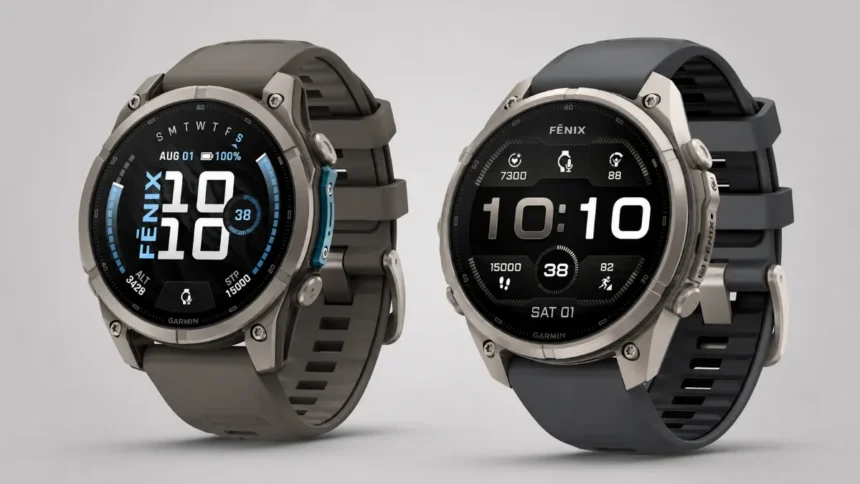
Garmin just pulled the curtain back on the Fenix 9 and Fenix 9 Pro, and if you’re someone who takes outdoor adventures seriously (or even just likes the idea of owning a watch that could survive a mountain), this is worth your attention.
The announcement came during Garmin’s “Play Harder” livestream on August 25, 2026, and pre-orders open on August 28. The lineup is bigger than you might expect, with five different configurations spanning two main models, multiple sizes, and optional solar and satellite connectivity.
- The Lineup at a Glance
- What’s Actually New on the Fenix 9
- A Display That’s Twice as Bright
- More Power Under the Hood
- Scratch-Resistant Sapphire Lens
- Leakproof Buttons, Dive-Rated to 40 Meters
- What Makes the Fenix 9 Pro Worth the Extra $100
- Full Titanium Case
- 3,000 Nits of Brightness
- InReach Satellite and LTE Connectivity
- Green Light Mode on the LED Flashlight
- 1.5-Inch AMOLED Display (51mm Only)
- Battery Life: The Numbers That Actually Matter
- New Software Features Worth Knowing About
- Fenix 9 vs. Fenix 8: Should You Upgrade?
- Who Is This Watch Actually For?
- Pre-Order Details
- Final Thoughts
Let’s get into what actually matters here.
The Lineup at a Glance
Before we dive into the details, here’s a quick overview of what Garmin is offering. This isn’t just a “Fenix 9” situation. It’s more like a family of watches.
| Model | Display | Sizes Available | Starting Price | Key Differentiator |
| Fenix 9 | AMOLED | 43mm, 47mm, 51mm | $999.99 | Base model with major upgrades |
| Fenix 9 Pro | AMOLED | 43mm, 47mm, 51mm | $1,099.99 | Full titanium case, brighter display |
| Fenix 9 Pro Solar | MIP (solar) | 47mm, 51mm | ~$1,199.99 | Solar charging, extended battery life |
| Fenix 9 Pro inReach | AMOLED | 43mm, 47mm, 51mm | ~$1,199.99 | Satellite + LTE connectivity |
| Fenix 9 Pro inReach Solar | MIP (solar) | 47mm, 51mm | ~$1,399.99 | Everything, all at once |
My take: The pricing hasn’t gone up from the Fenix 8, which is honestly surprising given the upgrades. Garmin could have easily bumped these by $100 across the board and nobody would have blinked.
What’s Actually New on the Fenix 9
Let’s talk about the base Fenix 9 first, because even without the “Pro” badge, this thing has gotten some serious upgrades.
A Display That’s Twice as Bright
The AMOLED screen on the Fenix 9 is now double the brightness of the Fenix 8. If you’ve ever tried to check your pace in direct sunlight and squinted at a dim screen, you know why this matters. The Fenix 9 Pro takes it even further with up to 3,000 nits of brightness, which is genuinely impressive for a watch this size.
More Power Under the Hood
- 50% more RAM than the Fenix 8
- 64GB of storage (doubled from 32GB), which means roughly 7,000 songs or twice as many downloadable maps
- Upgraded map engine with up to 30% faster panning
Scratch-Resistant Sapphire Lens
Every Fenix 9 comes with a sapphire lens. If you’ve ever scratched a watch face on a rock or a doorframe (we’ve all been there), this is the kind of thing you appreciate more than any software feature.
Leakproof Buttons, Dive-Rated to 40 Meters
Not that most people are diving with their Fenix, but knowing the buttons won’t let water in at depth is reassuring for swimmers and anyone who doesn’t want to worry about rain or showers.
What Makes the Fenix 9 Pro Worth the Extra $100
The Pro model is where things get really interesting. Here’s what you get for that additional hundred dollars:
Full Titanium Case
This is a first for the Fenix line. The standard Fenix 9 uses a fiber-reinforced polymer case with titanium accents, but the Pro goes full titanium. The result? It’s noticeably lighter and about 16% thinner than the Fenix 8 in the same size. For a watch you’re wearing 24/7, that weight difference adds up.
3,000 Nits of Brightness
While the base model is twice as bright as the Fenix 8, the Pro pushes to 3,000 nits. In practical terms, you’ll have an easier time reading this screen outdoors, even in bright sunlight.
InReach Satellite and LTE Connectivity
For the first time, satellite connectivity is available on all three Pro sizes (43mm, 47mm, and 51mm). Previously, you had to go with the larger case to get this feature. It requires an active inReach plan, and LTE network coverage is not available in all regions, but if you’re heading into backcountry where your phone has zero signal, being able to send an SOS or text via satellite is genuinely useful.
Green Light Mode on the LED Flashlight
The built-in flashlight now has a green light option alongside the existing white and red modes. Why does this matter? Green light helps preserve your night vision while still illuminating terrain more effectively than red. Hikers, campers, and trail runners who start before dawn will appreciate this one.
1.5-Inch AMOLED Display (51mm Only)
The largest Pro model gets Garmin’s first 1.5-inch AMOLED screen, which is 15% larger than the Fenix 8’s display. More screen real estate means easier map reading and less squinting at data fields mid-run.
Battery Life: The Numbers That Actually Matter
Battery life has always been Garmin’s trump card against the Apple Watch and Pixel Watch, and the Fenix 9 doesn’t disappoint. Here’s how it breaks down:
| Model & Size | Smartwatch Mode | GPS Mode | Max Battery Mode |
| Fenix 9 (43mm) | Up to 10 days | Up to 28 hours | Up to 49 hours |
| Fenix 9 (47mm) | Up to 16 days | Up to 47 hours | Up to 81 hours |
| Fenix 9 (51mm) | Up to 29 days | Up to 84 hours | Up to 145 hours |
| Fenix 9 Pro (51mm AMOLED) | Up to 31 days | Up to 56 hours | Up to 151 hours |
| Fenix 9 Pro Solar (51mm) | Up to 30 days / 57 days with solar | Up to 75 hours / 124 hours with solar | Up to 186 hours / 1,000 hours with solar |
The solar numbers come with a caveat: Garmin assumes you’re spending three hours per day outside in 50,000 lux conditions (basically bright, direct sunlight). That’s realistic if you’re an outdoor athlete, less so if you work at a desk all day.
Honest take: The 43mm model’s battery life is the one weak spot here. If battery life is your priority and you have smaller wrists, that’s a trade-off worth thinking about.
New Software Features Worth Knowing About
Hardware upgrades are great, but Garmin has also introduced some genuinely useful software features that come to both the Fenix 9 and Fenix 9 Pro.
Garmin Epic
This is the standout new feature, and it’s free for all Fenix 9 users. Epic lets you group multiple activities together into a single story. Think of it like this:
- Training for a marathon over 12 weeks? Group all your runs into one Epic and see cumulative stats.
- Doing a multi-day hike like the West Highland Way? Every day’s activity shows up on a single map.
- Going on a ski trip? All your runs, your sleep data, your recovery scores, all in one place.
You can log activities under one Epic for up to 92 days, add photos and notes, and share the whole thing with friends through Garmin Epic.
Why it’s cool: Most fitness watches treat every workout as an isolated event. Epic finally acknowledges that real adventures happen over days, weeks, and months, not just single sessions.
Enhanced Stamina Tracking
Garmin has added two new stamina features:
- Stamina Zones: Now visible in your post-activity summary, showing how much time you spent in different effort zones relative to your stamina capacity
- Stamina Curve: A visual representation of how your overall fitness is improving over time, factoring in both aerobic and anaerobic workouts
The system uses your VO2 max, lactate threshold, and training history to help with pacing and endurance during activities.
Expanded Rucking Features
If you’re into rucking (hiking or walking with a weighted pack), Garmin has added:
- The ability to edit your pack weight mid-activity (useful if you drop gear at camp)
- Calorie goals specific to rucking
- Structured rucking workouts through a collaboration with GORUCK
- A breakdown showing calories burned from hiking vs. additional calories from carrying weight
Better Maps and Navigation
- Up to 30% faster map rendering on Fenix 9
- New “Perspective View” that adds more detail both close-up and farther away to help users anticipate what is coming next, rather than a traditional top-down view
- Improved Explore Nearby function for finding points of interest on the fly
Fenix 9 vs. Fenix 8: Should You Upgrade?
This is the real question for existing Fenix 8 owners. Here’s a straightforward comparison:
| Feature | Fenix 8 | Fenix 9 | Fenix 9 Pro |
| Display brightness | Standard AMOLED | 2x brighter | 3,000 nits |
| Case material | Polymer + titanium accents | Polymer + titanium accents | Full titanium |
| Storage | 32GB | 64GB | 64GB |
| RAM | Standard | 50% more | 50% more |
| Map panning speed | Baseline | Up to 30% faster | Up to 30% faster |
| Sapphire lens | Optional | Standard | Standard |
| InReach (all sizes) | Fenix 8 Pro only | N/A | Yes, all sizes |
| Garmin Epic | No | Yes | Yes |
| Green flashlight mode | No | No | Yes |
| 1.5-inch display option | No | No | Yes (51mm) |
| Solar option | Yes | No | Yes |
My take: If you bought the Fenix 8 in the last year, there’s no urgent reason to upgrade unless you really want the titanium case or the brighter screen. But if you’re on a Fenix 7 or older, this is a significant jump in several areas.
For readers comparing premium wearables, Devicology’s Top 5 Best Smartwatches For 2026 also covers other major smartwatch options.
Who Is This Watch Actually For?
Let’s be honest about something. A $1,000+ smartwatch isn’t for everyone, and it doesn’t need to be. Here’s who should genuinely consider the Fenix 9:
- Trail runners and ultramarathon athletes who need multi-day battery life and detailed maps
- Hikers and backpackers who go off-grid and want satellite connectivity as a safety net
- Triathletes and multisport athletes who need a single watch that handles swimming, cycling, and running without compromise
- Data-driven fitness enthusiasts who want deep metrics beyond what an Apple Watch or Pixel Watch offers
- Anyone who hates charging their watch every day and wants something that lasts weeks, not hours
Who should probably skip it:
- Casual fitness users who mainly track steps and the occasional jog (a Garmin Venu or even a Forerunner would serve you better for less money)
- People who prioritize smart features like app ecosystems, phone notifications, and voice assistants (Apple Watch or Pixel Watch are better at that stuff)
- Anyone on a tight budget (the Garmin Forerunner 265 does 80% of what the Fenix does for half the price)
Pre-Order Details
- Pre-orders open: August 28, 2026
- Where to buy: Garmin.com and authorized retailers
- Price range: $999.99 to $1,399.99 depending on configuration
- Sizes: 43mm, 47mm, and 51mm (Solar models start at 47mm)
- Band options: Multiple color combinations plus new ComfortFit accessory bands with a split-weave design
Final Thoughts
The Fenix 9 isn’t a revolutionary leap from the Fenix 8. It’s more like a very thorough refinement of what was already the best outdoor smartwatch on the market. The brighter screen, the titanium case, the doubled storage, and the faster maps all add up to a noticeably better experience.
But the real story here is Garmin Epic. It’s the kind of feature that changes how you think about tracking your fitness. Instead of isolated workouts floating in a void, you get a connected narrative of your training and adventures. That’s something no other watch brand is doing this well right now.
If you’re in the market for a serious outdoor watch and you’ve been waiting to see what Garmin would do next, the wait is over. Pre-orders go live on August 28. Just make sure you know which configuration you want before you click “buy,” because with five options across multiple sizes, there’s a lot to choose from.