
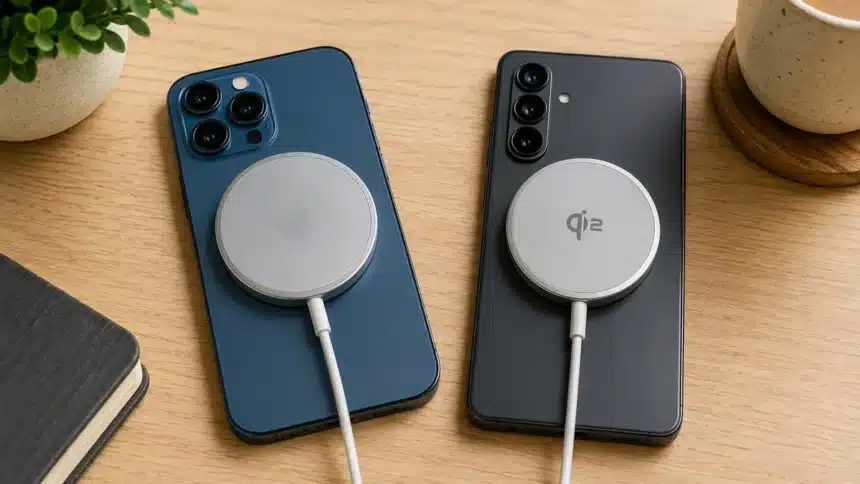
You may have seen it before you knew what it was called: a ring of magnets on the back of a phone or charger that lets them snap together and charge without having to find the right spot. The box will sometimes say “MagSafe.” Sometimes it says “Qi2.” It says both sometimes. Because of this overlap, many people wonder whether MagSafe and Qi2 are the same thing.
In a few words, MagSafe vs. Qi2 isn’t a case of two completely different charging technologies. They’re related, but not the same. Apple’s own charging system is called MagSafe. While MagSafe was the model for Qi2, Apple helped make the underlying magnetic alignment approach part of an open industry standard. That means the following for your next charger purchase.
MagSafe – The Origin
MagSafe wasn’t the first wireless charger. The Wireless Power Consortium (WPC) created the original Qi standard in 2010. It works via electromagnetic induction: a coil in the charging pad creates a magnetic field, and a matching coil in the phone converts that field into usable current. It works, but you have to be careful where you put it. If you move the phone even a few millimeters out of center, the charging speed can slow down or stop altogether.
Apple addressed this by putting a ring of magnets around the charging coil. In 2020, Apple introduced MagSafe as a built-in feature with the launch of the iPhone 12 series. The magnets help guide the phone into the correct position so the charging coils line up properly. It really did work.
Charging power went from up to 7.5W with regular Qi charging on compatible iPhones to up to 15W with the original MagSafe implementation, and alignment became much more consistent. The catch was that MagSafe was part of Apple’s ecosystem. Accessory makers needed Apple’s MagSafe certification for MagSafe-branded products and certain supported capabilities, while Android phones didn’t initially benefit from the system in the same way.
If you’ve ever wondered why many iPhone cases have that circle on the back, it is there to help compatible MagSafe accessories align with the phone correctly.
How Qi2 Grew Out of MagSafe
In 2023, the WPC released Qi2. Actually, it’s not really a rival; it’s more like an addition to the idea behind MagSafe.
The “Magnetic Power Profile” in the Qi2 standard builds on the idea of magnetic alignment used in MagSafe and contributed by Apple to the WPC. Accessory makers can build Qi2-certified products around this magnetic alignment standard without requiring Apple’s MagSafe certification. They still need to meet WPC requirements to use Qi2 certification.
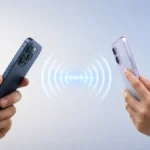
In practice, this means a Qi2-certified charger can snap onto a compatible MagSafe iPhone and charge it. Also, since both use a similar magnetic alignment system, many MagSafe accessories can physically work with Qi2-compatible phones. Android phones can now really charge with a magnetic snap, too. The magnet array is built into some compatible models, while Qi2 Ready phones can rely on a compatible magnetic case to provide the complete magnetic charging experience.
Then Came Qi2 25W
The standard did more than just match MagSafe’s original 15W. The WPC launched Qi2 25W in 2025. It magnetically attaches in much the same way, but the maximum power is bumped up to 25W.
Compatible newer iPhones can also support wireless charging at up to 25W, depending on the model and charging setup. Apple’s current MagSafe system itself can reach up to 25W on compatible iPhones, while Qi2 25W provides the higher-power tier through the WPC standard. Actual charging power still depends on the phone, charger, and USB-C power adapter being compatible with the required charging rate.
This means that “MagSafe” and “Qi2” should not automatically be treated as fixed wattage labels. The real number depends on the phone, charger, power adapter, and the versions and capabilities they support.
MagSafe vs. Qi2 vs. Qi2 25W: Side by Side
Here’s a look at MagSafe and Qi2 next to each other:
| Feature | MagSafe | Qi2 | Qi2 25W |
| Governing body | Apple | Wireless Power Consortium | Wireless Power Consortium |
| Origin | Introduced with iPhone 12 in 2020 | Introduced in 2023, building on magnetic alignment technology contributed by Apple | Launched in 2025 as a higher-power Qi2 tier |
| Max speed | Up to 25W on compatible newer iPhones; older models may have lower limits | Up to 15W | Up to 25W |
| Magnetic alignment | Yes | Yes | Yes |
| Device support | Compatible iPhones and MagSafe accessories | Qi2-certified devices and compatible iPhones | Qi2 25W-certified compatible devices |
| Certification | Apple-controlled for MagSafe branding and supported features | WPC-certified, brand-agnostic | WPC-certified, brand-agnostic |
| Cross-compatibility | Many accessories can work across compatible Qi2 and MagSafe devices, although features and charging speeds can vary | Works with compatible MagSafe-equipped iPhones and Qi2 devices | Backward compatibility is possible, with charging limited by the capabilities of the device and charger |
| Foreign object detection | Yes | Yes | Yes |
| Typical accessory pricing | Often at a premium for MagSafe-certified products | Often available across a wider range of brands and prices | Pricing varies by brand, features, and wattage |
Does Qi2 Actually Work With MagSafe Accessories?
Most of the time, that’s true. A Qi2 stand or power bank can fit and charge a compatible MagSafe iPhone because Qi2’s Magnetic Power Profile is based on a similar magnetic alignment approach. Many MagSafe accessories can also physically work with Android phones that support Qi2.
However, compatibility is not necessarily identical in every case. Some features remain specific to Apple’s ecosystem, while magnet placement, charging capabilities, and accessory support can vary between products. You probably won’t notice a major difference between the two standards for basic magnetic charging unless a particular MagSafe feature or maximum charging speed is important to your whole setup.
Which One Should You Actually Buy?
There are two types of chargers that can work well if you only use Apple products: MagSafe and Qi2. Qi2 accessories are also available from a wide range of manufacturers, which can give you more choices at different price points.
If you have an Android phone, Qi2 can give you magnetic wireless charging on supported devices. Make sure your phone has built-in magnetic support or check whether it is Qi2 Ready and requires a compatible case first. If speed is very important to you, make sure the phone, charger, and power adapter all support the charging rate you want. The slowest part of that chain can limit the final charging speed.
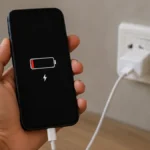
And if your phone refuses to charge even with a compatible charger, the problem may not be MagSafe or Qi2 at all. Devicology’s guide on how to fix a phone that won’t charge covers charger compatibility, placement, cables, adapters, and other common charging problems.
The Bottom Line
MagSafe and Qi2 are different, but they don’t really go up against each other. Qi2 brings one of the things MagSafe did well, accurate magnetic alignment, to a broader industry standard. With Qi2 25W, that idea is strengthened by adding more power. Simply put, it takes an idea Apple introduced with MagSafe in 2020 and makes a similar magnetic charging approach available across a wider range of compatible devices and accessories.